Muji Japan Shopping Guide 2026-2027: What to Buy and How Tax-Free Works Now
25 Must-Buy MUJI Items, Rated for Gifting, Packing and Japan-Only Value


- +0 0
-

-


If you already know MUJI from home, you might expect the stores in Japan to be the same thing in a bigger building: notebooks, storage boxes, plain T-shirts. Those are all here, and plenty of people in Japan buy them. But look at what actually sells. MUJI’s best-selling product across Japan in 2025 was not a pen or a storage box. It was a pouch of butter chicken curry.
I’m Yusukes, a Tokyo-based travel writer, and I’ve been shopping at MUJI regularly for more than a decade. If you’re wondering what to buy in MUJI in Japan, my advice is simple: start with the food aisle. It’s the quickest way to see what makes Japanese MUJI different, the prices are low, and most of it fits easily in a suitcase.
This guide covers food, snacks, skincare, Japanese kitchen items and travel gear, plus a few basics at the end. To choose them, I went through MUJI’s own sales data, including its online store ranking for the first half of 2026 (January to June, published in July 2026) and its 2025 annual ranking, then added long sellers I’ve watched on store shelves over the years and a few items I’d recommend because they’re so distinctly Japanese. Prices are as of October 2026, and all prices include Japan’s consumption tax. MUJI changes its lineup often and some items are seasonal, so a few things here may have moved or disappeared by the time you visit.
Before You Grab a Basket: What to Buy in MUJI Japan
Here’s every item in this guide in one table, so you can plan your shopping list before reading the details.
How I rated each item: 🎁 Giftable shows how well an item works as a gift. 🧳 Easy to pack means more stars for things that are small, light and hard to break. 🇯🇵 Japan-only advantage is based on a check of MUJI’s overseas online stores as of October 2026. High means I couldn’t find the item on any overseas MUJI site, Medium means it’s sold in a country or two besides Japan, such as Malaysia or Australia, and Low means it’s also sold in the US. Not finding an item online doesn’t guarantee it isn’t sold in a store somewhere, so treat High as a strong hint rather than a promise. And Low doesn’t mean an item will be easy to get where you live. It may not be stocked at your local store, and as the baumkuchen example below shows, it can cost several times more than in Japan. Considering both availability and price, I’d recommend buying everything on this list in Japan.
| Item | 🎁 Giftable |
🧳 Easy to pack |
🇯🇵 Japan-only |
|---|---|---|---|
| Ready-to-Eat Meals | |||
| Butter Chicken Curry | ★★★☆☆ | ★★★★☆ | Medium |
| Babaocai for Rice | ★★★☆☆ | ★★★★☆ | High |
| Stewed Hamburger Steak with Tomato Sauce | ★☆☆☆☆ | ★★★★☆ | Medium |
| Pork & Vegetable Miso Soup | ★★★★☆ | ★★★★☆ | High |
| Ramen Noodles with Seafood Soy Sauce Broth | ★★★★★ | ★★★★☆ | High |
| Snacks | |||
| Chocolate Yokan | ★★★★☆ | ★★★★★ | Medium |
| Cultured Butter Baumkuchen | ★★★★★ | ★★★★☆ | Low |
| Sweet Potato Sticks | ★★★★★ | ★★★★☆ | Medium |
| Salted Rice Crackers | ★★★★★ | ★☆☆☆☆ | High |
| Seaweed Rice Crackers | ★★★★★ | ★★★★☆ | Medium |
| White Chocolate Coated Strawberries | ★★★★★ | ★★★★★ | Medium |
| Skincare | |||
| Booster Serum | ★★★☆☆ | ★★★★☆ | Low |
| Booster Essence Lotion | ★★★☆☆ | ★★★☆☆ | Low |
| Natural Water-Based Body Mist | ★★★★☆ | ★★★☆☆ | High |
| Mild Gel Cleansing, Large | ★★★☆☆ | ★★★☆☆ | Medium |
| Lip Essence, Pink | ★★★☆☆ | ★★★★★ | High |
| Cleansing & Refreshing Mask | ★★☆☆☆ | ★★★☆☆ | High |
| Kitchen | |||
| Silicone Multipurpose Band | ★★☆☆☆ | ★★★★★ | Low |
| Bamboo Steamer, Large | ★★★☆☆ | ★★☆☆☆ | Medium |
| Wooden Lacquered Lunchbox | ★★★★★ | ★★★★☆ | Low |
| Sakura Chopsticks, Octagonal | ★★★★★ | ★★★★★ | Low |
| Travel Gear | |||
| Dry Shampoo | ★★☆☆☆ | ★★★★☆ | Medium |
| Silicone Identification Band S | ★★☆☆☆ | ★★★★★ | High |
| Recycled Polyester Gusset Compression Case | ★★☆☆☆ | ★★★★★ | Low |
| Passport Case with Pocket | ★★☆☆☆ | ★★★★★ | Low |
New to MUJI? Start With These Three
If you’ve never shopped at MUJI before, or you only have a few minutes, these three give you a quick taste of what MUJI Japan does best.
- Butter Chicken Curry (¥390): MUJI’s best-selling item across Japan in 2025, and mild enough for almost anyone.
- Cultured Butter Baumkuchen (¥190): A cheap, light snack from MUJI’s long-selling “uneven” baumkuchen line.
- A skincare item that suits your skin: For example, the Booster Essence Lotion (¥1,590) from MUJI’s popular fermented skincare series.
Both the curries and the baumkuchen come in many flavors, so feel free to pick whichever one catches your eye.
Why Shop at MUJI in Japan?
You’ll find it almost everywhere
MUJI had 726 stores in Japan at the end of September 2026, out of 1,498 worldwide, and there’s at least one in every one of Japan’s 47 prefectures, from Hokkaido to Okinawa. You’ll find them in station buildings, shopping malls and department stores. A selection of around 250 MUJI items is also sold at Lawson convenience stores. If you forget socks or face wash, there’s a good chance MUJI is closer than you think.
The home country has the widest range
MUJI was born in Japan in 1980 as a private brand of the Japanese supermarket chain Seiyu, with just 40 products. Japan still has the widest range by far, from the world flagship store in Ginza to the largest MUJI anywhere, which opened in Kashihara, Nara Prefecture, in March 2025.
That matters more than it sounds. Products sold only in Japan are fewer than you might think, but plenty of items are sold in just a handful of countries, and your country may not be one of them. Many of the products in this guide fall into that gap. MUJI USA’s online store, for example, sorts its food into snacks, dried soups and drinks, with no section for ready-to-eat curries. Japanese stores also carry whole categories you rarely see abroad, including a section of everyday disaster-prep goods called いつものもしも (itsumo no moshimo, roughly “everyday, just in case”). So even if there’s a MUJI near your home, don’t assume you can get the same things there.
It may cost less than at home
Here’s one concrete example. The Cultured Butter Baumkuchen in the snack section below costs ¥190 in Japan. MUJI USA sells the exact same product, with the same product code, for $4.90. At the mid-September 2026 rate of about ¥156 to the dollar, that’s roughly ¥770, about four times the Japanese price, and that’s before US sales tax. Not every item has that kind of gap, and exchange rates move, so compare a few things you already buy at home before you stock up.
Before You Shop: Tax-Free and Packing
Tax-free shopping changes on November 1, 2026
From November 1, 2026, Japan’s tax-free system works differently. Instead of paying the tax-free price at the register, you pay the full price, including tax, at the store. You get the tax back after customs confirms at your departure airport or seaport that you’re taking the goods out of Japan.
A few rules matter for MUJI shoppers:
- Your purchases must total at least ¥5,000 before tax, at one store, on one day.
- You must go through the customs check within 90 days of purchase, before you check your bags. Once a suitcase is checked, you can’t get it back for the check.
- Customs checks items one receipt at a time. If even one item from a receipt is missing, you lose the refund for everything on that receipt.
- Food and cosmetics no longer come in sealed tax-free bags, but if you eat or use them in Japan, they don’t qualify for a refund.
The practical answer: split your receipts. Buy the snacks you’ll eat during your trip separately from the ones you’re taking home. And ask staff at the register how MUJI will pay the refund, since stores can handle it themselves or through a refund company.
For the full process, from registering your refund at the till to the customs check at the airport, see our Japan tax-free shopping guide.
If you’re shopping before November 1, the old system still applies: line up at a register marked “Tax-free” and show your original passport with its entry stamp.
Muji Week discounts and tax-free don’t mix
MUJI’s 10% off member sale, Muji Week (無印良品週間), can’t be combined with tax-free shopping; see “Is There a MUJI Sale?” below for how it works and which one to choose.
Check your home country’s food rules
Several of the best items below contain meat. Many countries restrict meat products in passenger luggage, even in sealed pouches, so check your country’s rules before packing them. Bamboo and wooden items may also need to be declared in some countries.
What to Buy in MUJI: Ready-to-Eat Meals
This section covers three formats: retort pouches (レトルト), which are shelf-stable meals you heat and eat, freeze-dried soup, and dried instant noodles. All of them are light and pack easily, and MUJI’s ready-to-eat meals are some of the best sellers in its entire Japanese lineup. If you’re bringing them home, check your country’s rules first, since all of the ones below contain meat or meat-based ingredients.
Planning to eat them at your hotel? For the pouches, two words on the back tell you how to heat them: 湯せん (yusen) means put the sealed pouch in boiling water, and 電子レンジ (denshi renji) means microwave. If you see 不可 next to either, it means “not allowed.” The freeze-dried soup only needs hot water, while the ramen needs a pot to boil the noodles. Before you buy, check what your room has: a microwave, a kettle or a pot.
Butter Chicken Curry (素材を生かしたカレー バターチキン)
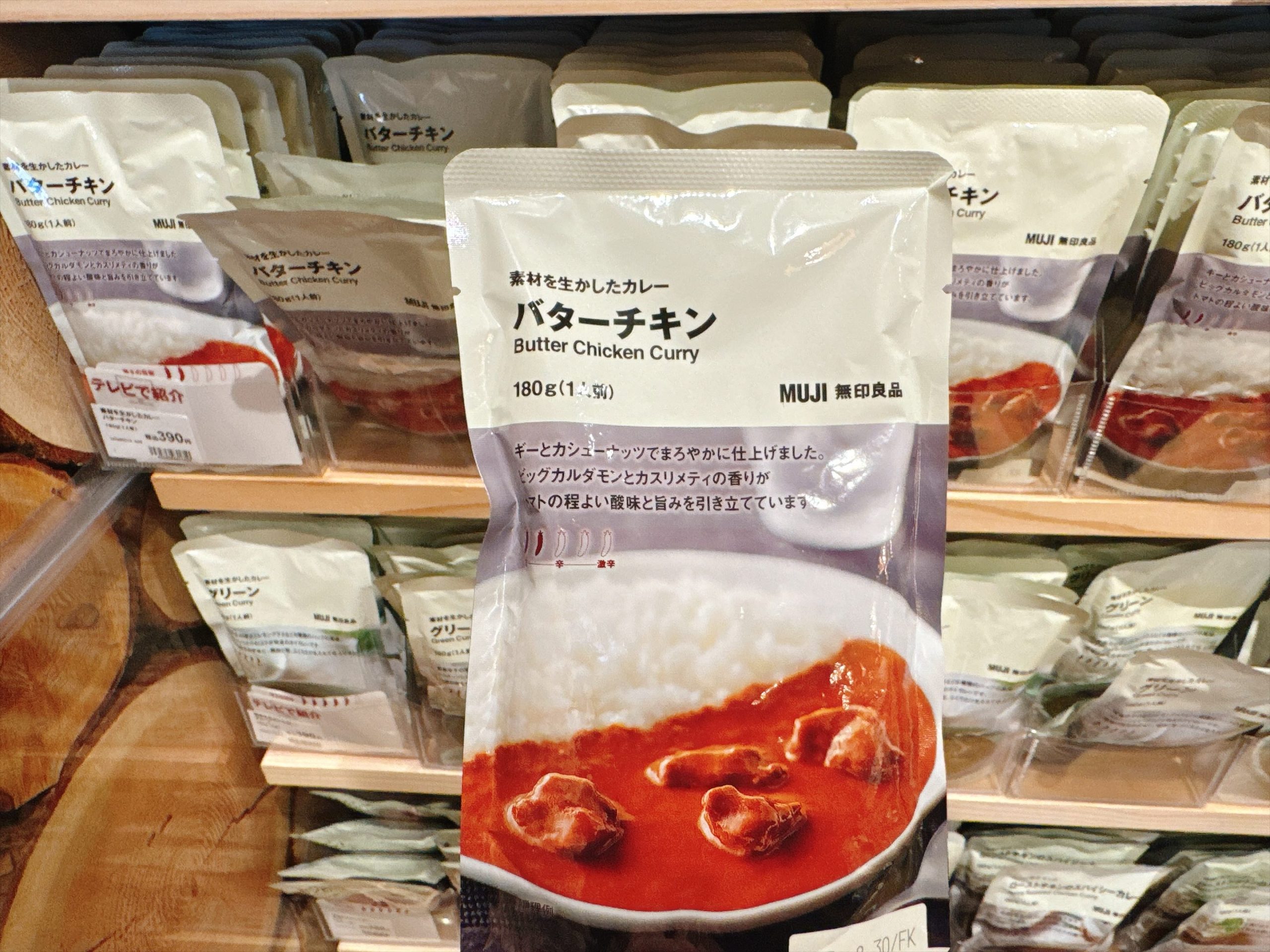
This is the one with the numbers behind it. It was MUJI’s top-selling item across all categories in 2025, and in MUJI’s online ranking for January to June 2026, it came third overall and first among ready-to-eat meals. It first came out in 2009. The current version, the sixth, launched in 2024 and is made with ghee, cashews and big cardamom for a smoky aroma.
On MUJI’s own heat scale it’s a 2 (marked 2辛 on the package), so it’s mild enough for most people.
If you like it, the same curry series has plenty of other popular flavors. I’d also recommend the beef curry (素材を生かした おうちのこだわりビーフカレー) and the keema curry (素材を生かしたカレー キーマ).
Price: ¥390
Size: 180g, one serving
Contains chicken
🎁 Giftable: ★★★☆☆
🧳 Easy to pack: ★★★★☆
🇯🇵 Japan-only advantage: Medium
Babaocai for Rice (ごはんにかける 八宝菜)
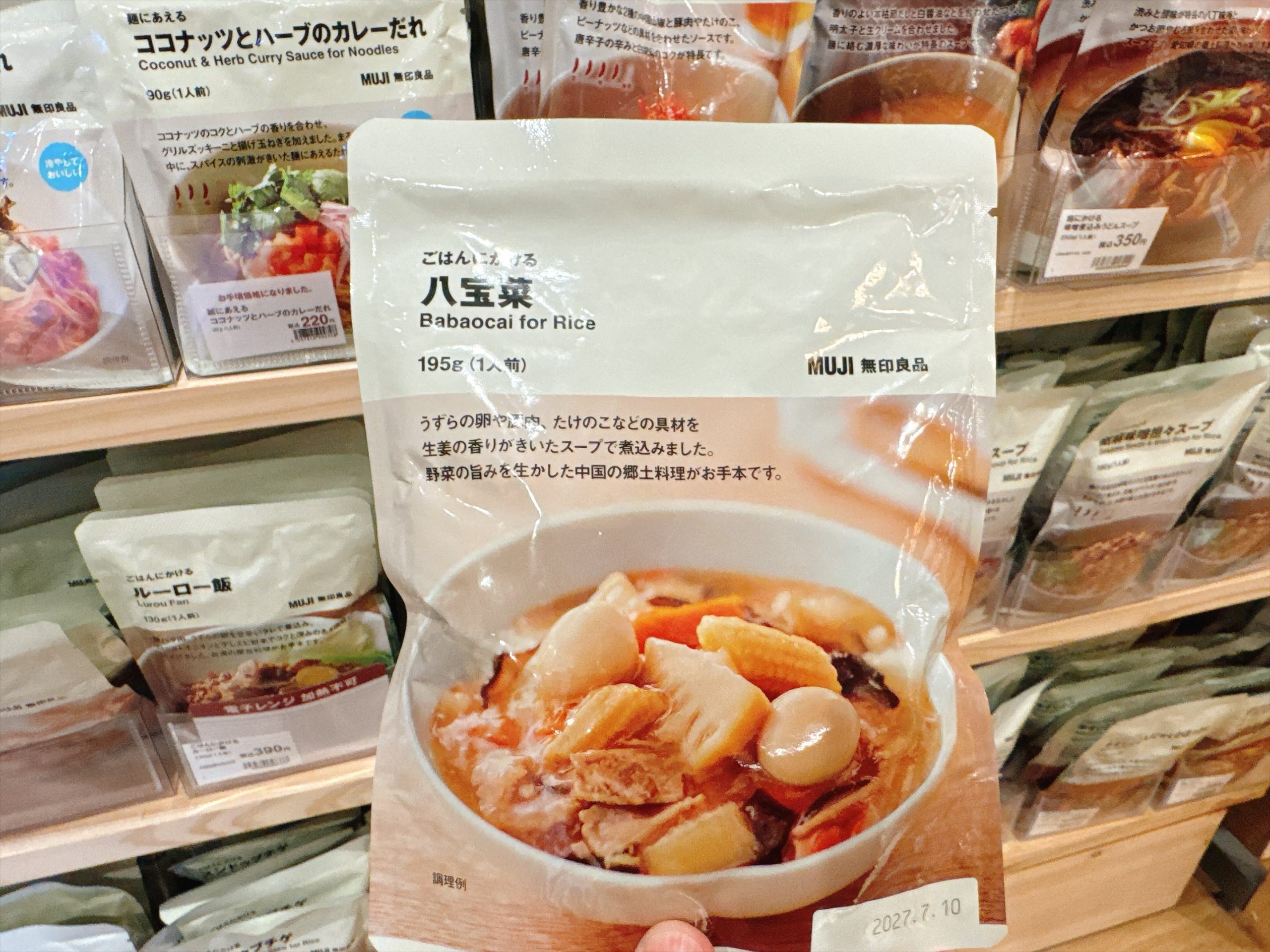
Curry isn’t the only thing MUJI Japan makes to pour over rice.
Babaocai is the Chinese reading of 八宝菜. In Japan, the same dish is called happosai, and it’s a standard at Japanese-Chinese (chuka) restaurants. The name means “eight treasures,” a nod to the many ingredients rather than an exact count. Meat, seafood or both are stir-fried with plenty of vegetables, then coated in a glossy sauce thickened with starch, so it clings to rice.
MUJI’s version has nine ingredients: pork, quail eggs, napa cabbage, baby corn, bamboo shoots, carrots, onions, shiitake and wood ear mushrooms, in a thick sauce with a clear ginger kick. It belongs to MUJI’s ごはんにかける (gohan ni kakeru, “pour over rice”) series and was the runner-up among ready-to-eat meals in that same online ranking.
The rest of the series is worth a look too. My other picks are the sesame miso dandan soup (ごはんにかける 胡麻味噌担々スープ) and the Thai-style gapao (ごはんにかける ガパオ).
Price: ¥350
Size: 195g
Contains pork
Do not microwave (contains quail eggs, which can burst); heat in boiling water
🎁 Giftable: ★★★☆☆
🧳 Easy to pack: ★★★★☆
🇯🇵 Japan-only advantage: High
Stewed Hamburger Steak with Tomato Sauce (素材を生かした トマトの煮込みハンバーグ)
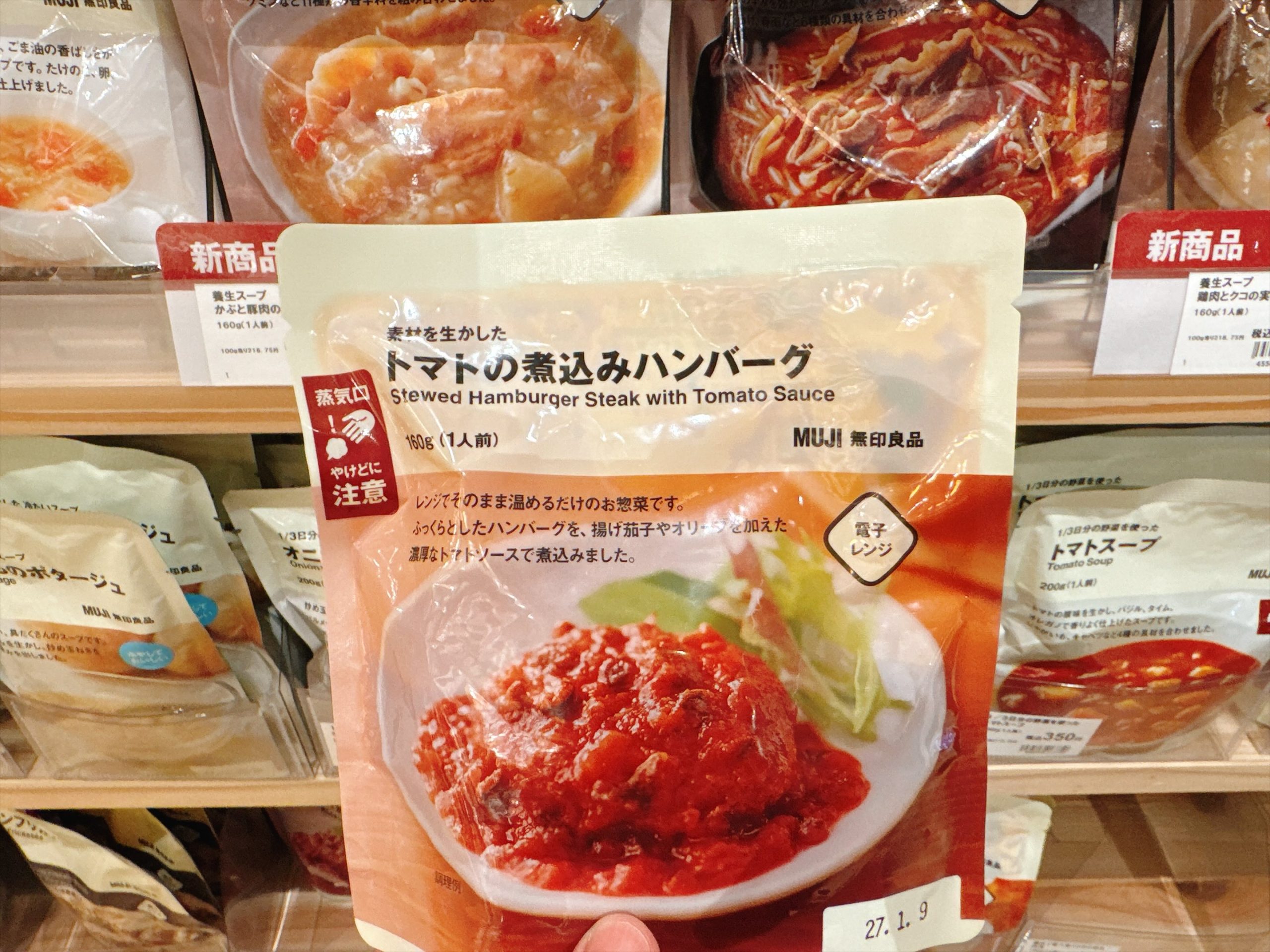
This is Japan’s take on hamburger steak. The patty mixes pork, chicken and beef and is simmered in a rich tomato sauce with fried eggplant and olives.
Hamburg steak (hanbagu) is part of yoshoku, the family of Western-inspired dishes that Japan has made its own. It’s a good pick if you want to try the Japanese version of something familiar.
Price: ¥390
Size: 160g
Contains pork, chicken and beef
Can be microwaved in its pouch, no bowl needed
🎁 Giftable: ★☆☆☆☆
🧳 Easy to pack: ★★★★☆
🇯🇵 Japan-only advantage: Medium
Pork & Vegetable Miso Soup (素材を生かした味噌汁 豚汁)
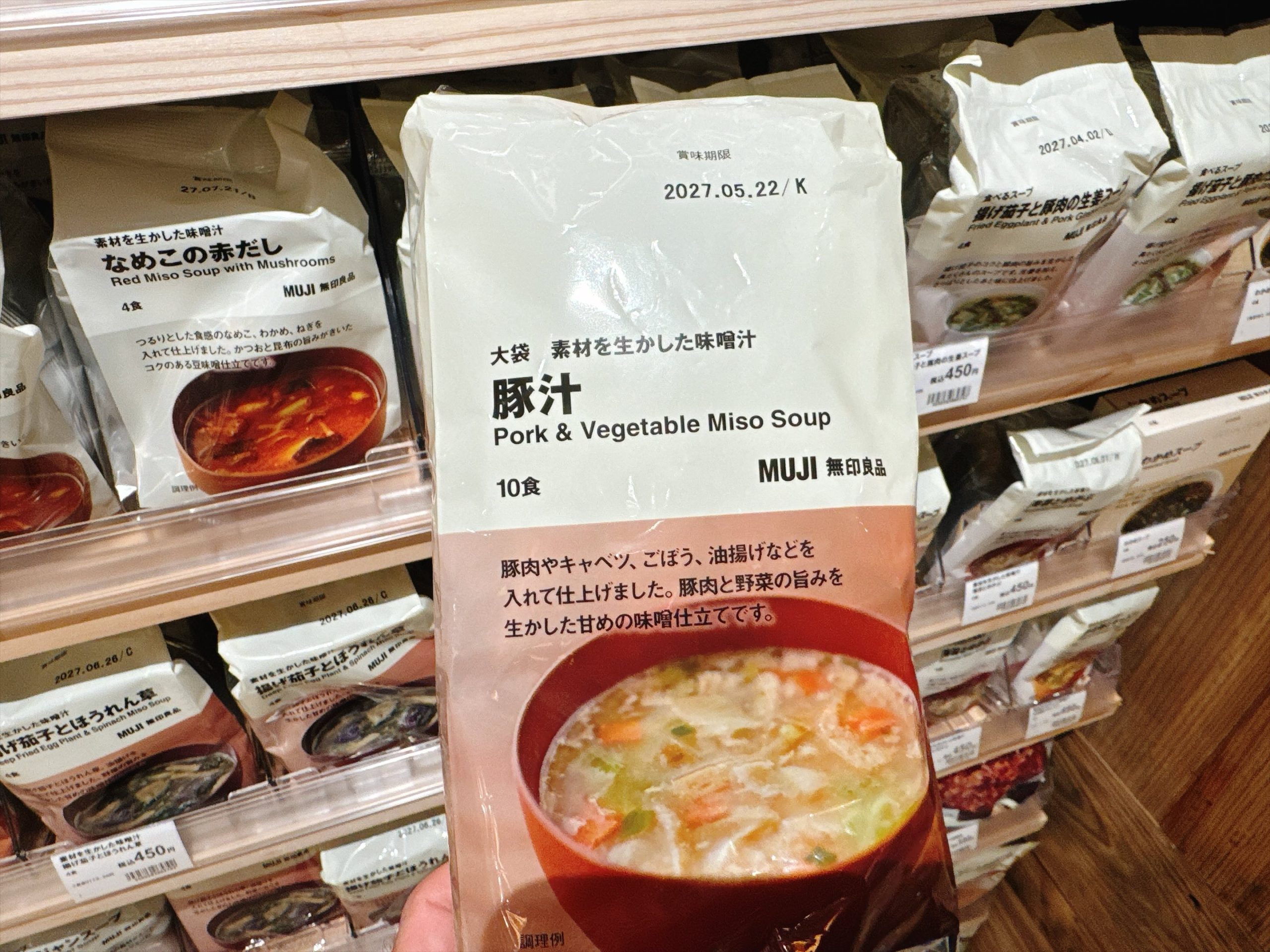
Miso soup has become better known around the world, both for its flavor and as a healthy dish. Tonjiru is miso soup with pork and vegetables, much heartier than the small bowl that comes with a set meal, and one of the most common soups in Japanese home cooking. MUJI’s version is freeze-dried, so you just add hot water to get pork, cabbage, burdock root and fried tofu in a slightly sweet miso broth. I included it because it’s a taste of everyday Japanese food that most travelers never get to try.
From the same miso soup series, I’d also recommend the red miso soup with nameko mushrooms (素材を生かした味噌汁 なめこの赤だし). If you prefer something closer to Western flavors, MUJI’s 食べるスープ (taberu soup, “soups to eat”) series includes a five-vegetable minestrone (5種野菜のミネストローネ).
Price: ¥450 (4 servings)
Freeze-dried, just add hot water
Contains pork
🎁 Giftable: ★★★★☆
🧳 Easy to pack: ★★★★☆
🇯🇵 Japan-only advantage: High
Ramen Noodles with Seafood Soy Sauce Broth (生麺を熟成乾燥させたラーメン 魚介しょうゆ)
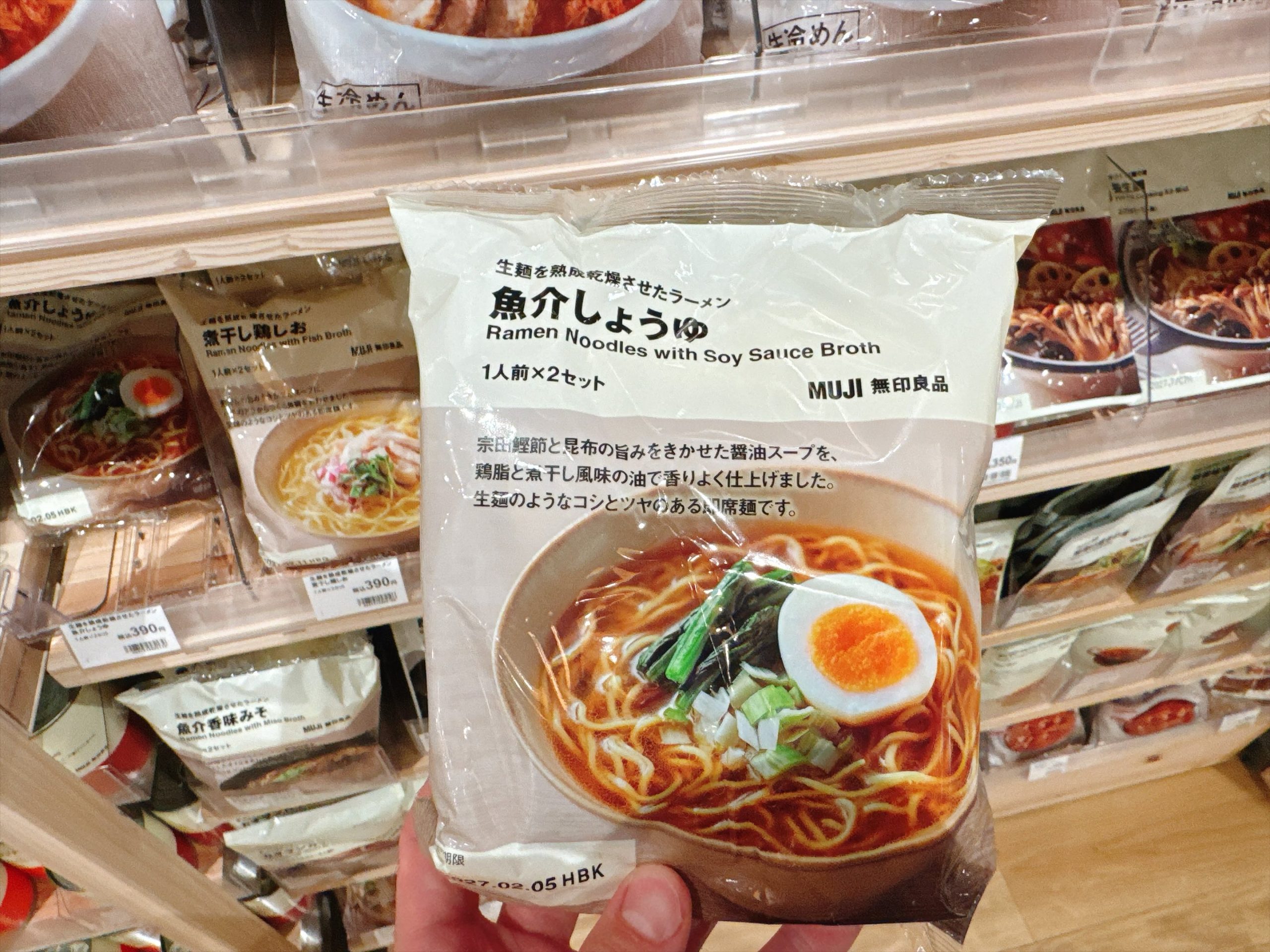
Ramen is one of the most popular foods in Japan, and ramen shops are one of my favorite things about living in Tokyo. You can’t pack a ramen shop in a suitcase, but you can take home a good instant version. These are dried noodles rather than a ready-to-eat meal: as the Japanese name says, the noodles start fresh and are then aged and dried without heat, which gives them a firmer, glossier texture than most instant noodles. The soy sauce broth is built on dried bonito and kombu and finished with chicken fat and a dried sardine-flavored oil. Each pack makes two servings. If you plan to eat it at your hotel, you’ll need a pot: the noodles boil in about 450mL of water for four and a half minutes, then you stir in the soup.
Price: ¥390 (2 servings)
Soup contains chicken fat
🎁 Giftable: ★★★★★
🧳 Easy to pack: ★★★★☆
🇯🇵 Japan-only advantage: High
Japanese Snacks to Bring Home
Buy these near the end of your trip, keep them unopened, and keep them on their own receipt if you’re claiming a tax refund.
Chocolate Yokan (備蓄おやつ チョコようかん)
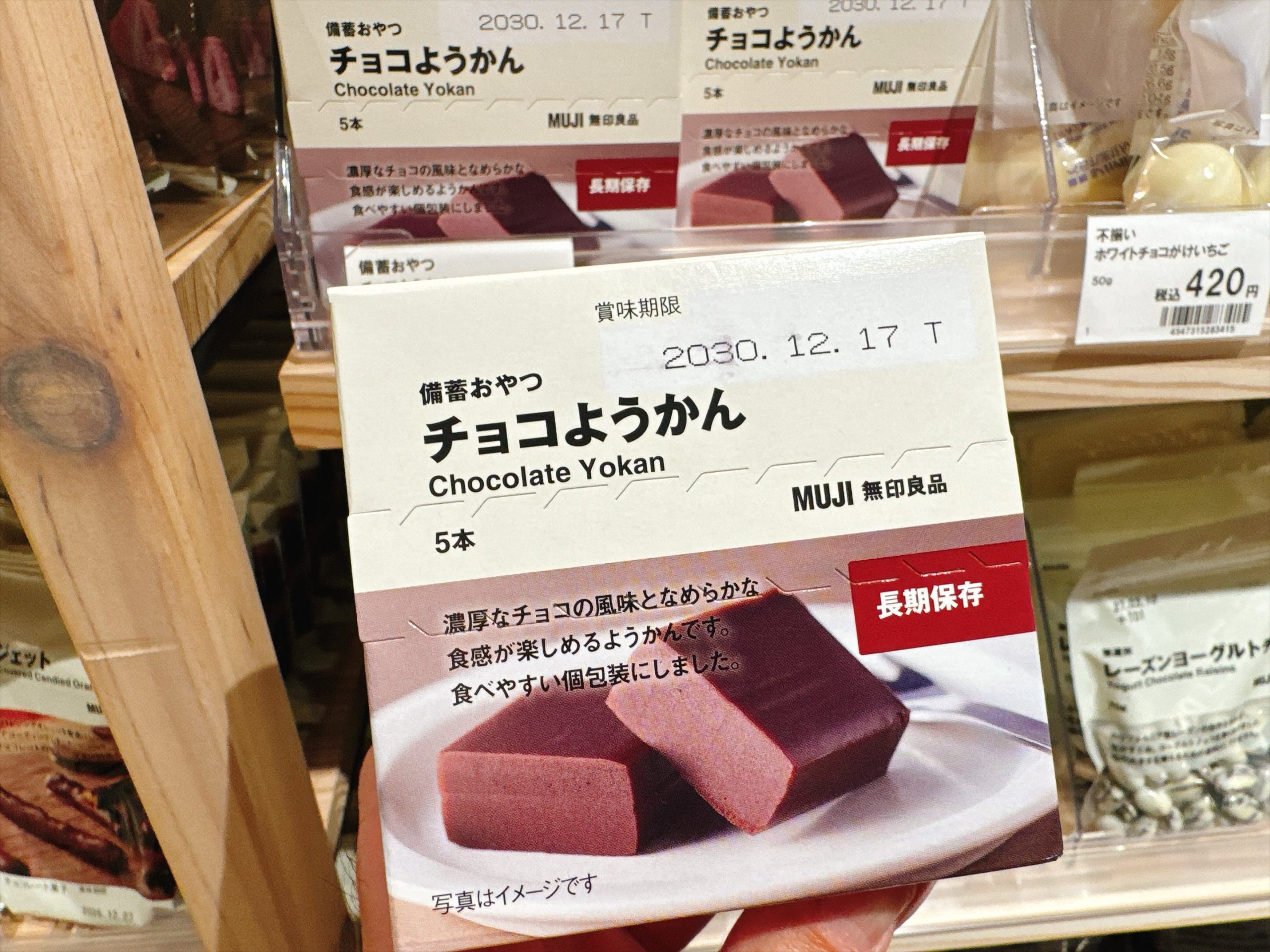
The name tells you what it’s for. 備蓄おやつ (bichiku oyatsu) means “stockpile snack,” and it’s designed to keep for a long time in an emergency kit. Yokan is a firm, traditional Japanese sweet usually made from sweet bean paste, and MUJI’s version is chocolate flavored. It also topped the snack category in MUJI’s mid-2026 online ranking. Reviewers on MUJI’s Japanese site mention keeping it as “rolling stock,” eating it and replacing it as they go.
Price: ¥950
🎁 Giftable: ★★★★☆
🧳 Easy to pack: ★★★★★
🇯🇵 Japan-only advantage: Medium
Cultured Butter Baumkuchen (不揃い 発酵バターバウム)
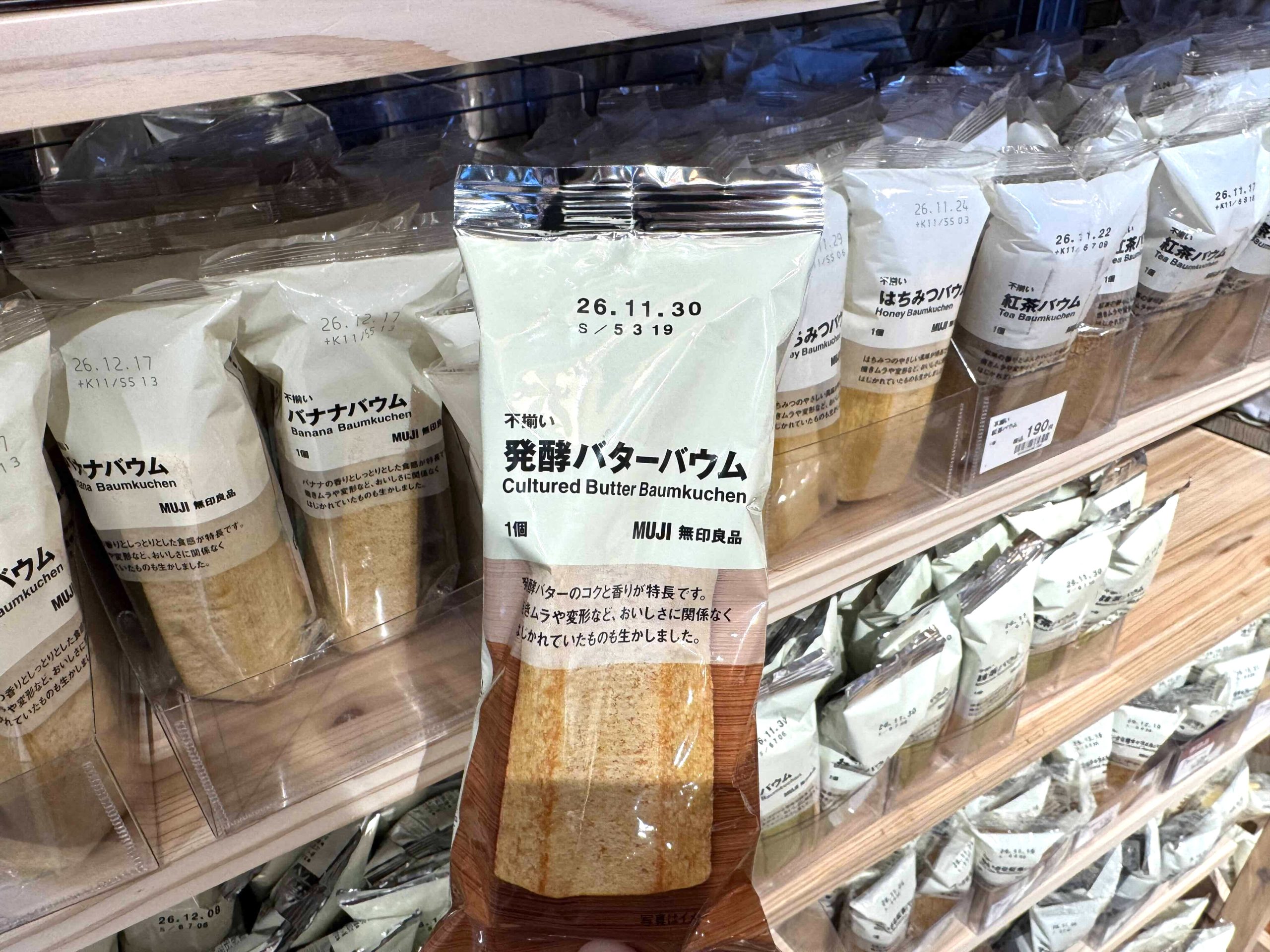
Look for 不揃い (fuzoroi) on the label. It means “uneven.” MUJI’s baumkuchen line uses the ends and irregular pieces that would otherwise be thrown away during baking, and it has been a long seller on exactly that value. The cultured butter flavor is the recent favorite, placing third among snacks in that mid-year ranking.
Still, if you only pick one, I’d go with the banana (不揃い バナナバウム), the classic of the line. For a flavor you’re unlikely to find outside Japan, try the matcha (不揃い 抹茶バウム). Baumkuchen is also sold at Lawson.
Price: ¥190
🎁 Giftable: ★★★★★
🧳 Easy to pack: ★★★★☆
🇯🇵 Japan-only advantage: Low
Sweet Potato Sticks (芋けんぴ)
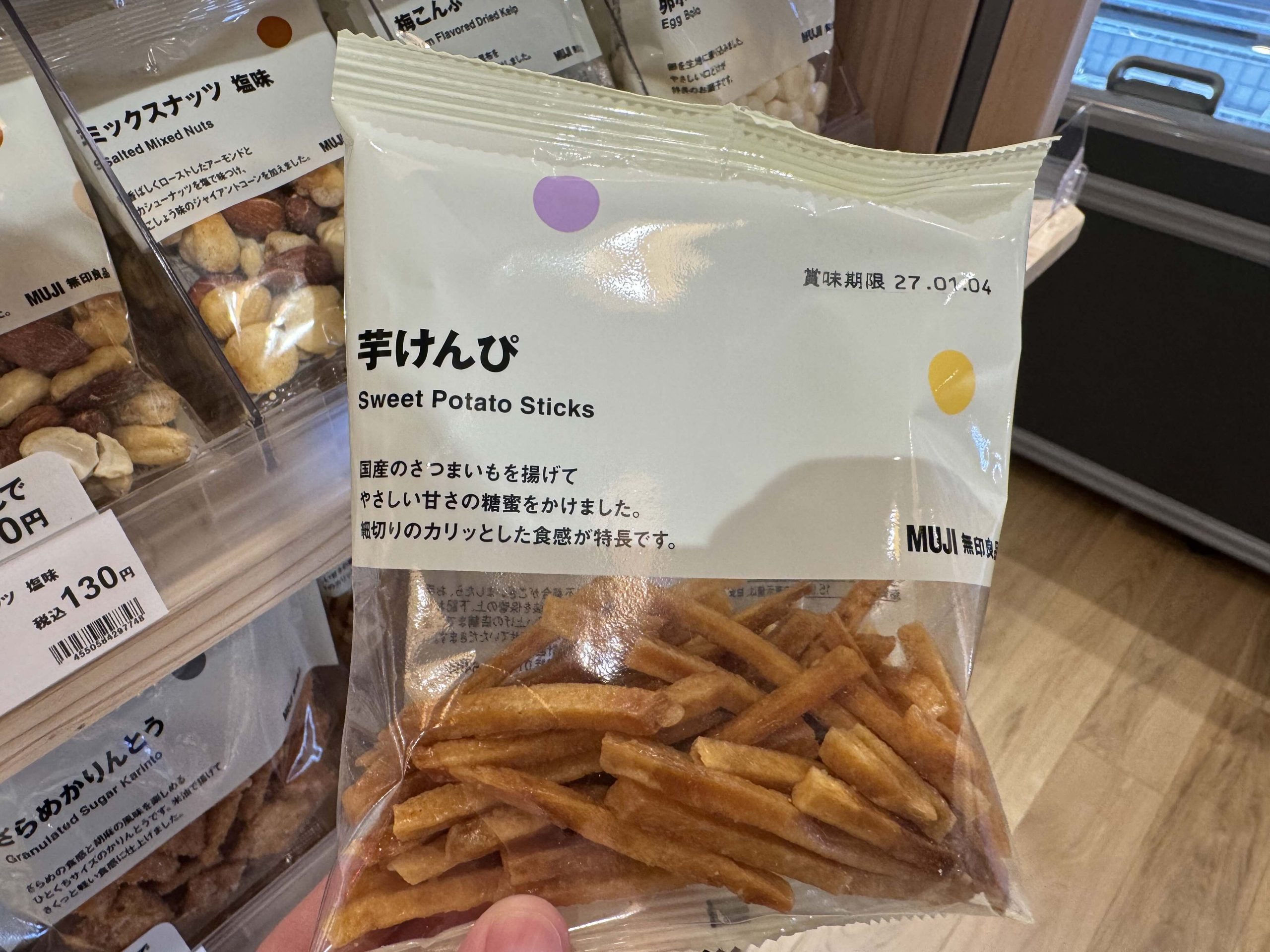
Imo-kenpi are crunchy sticks of fried sweet potato coated in sugar, a classic Japanese snack. MUJI’s version was the best-selling snack in its 2025 annual ranking, and reviewers often mention that a light saltiness keeps it from being too sweet.
Price: ¥130
🎁 Giftable: ★★★★★
🧳 Easy to pack: ★★★★☆
🇯🇵 Japan-only advantage: Medium
Salted Rice Crackers (塩せんべい)
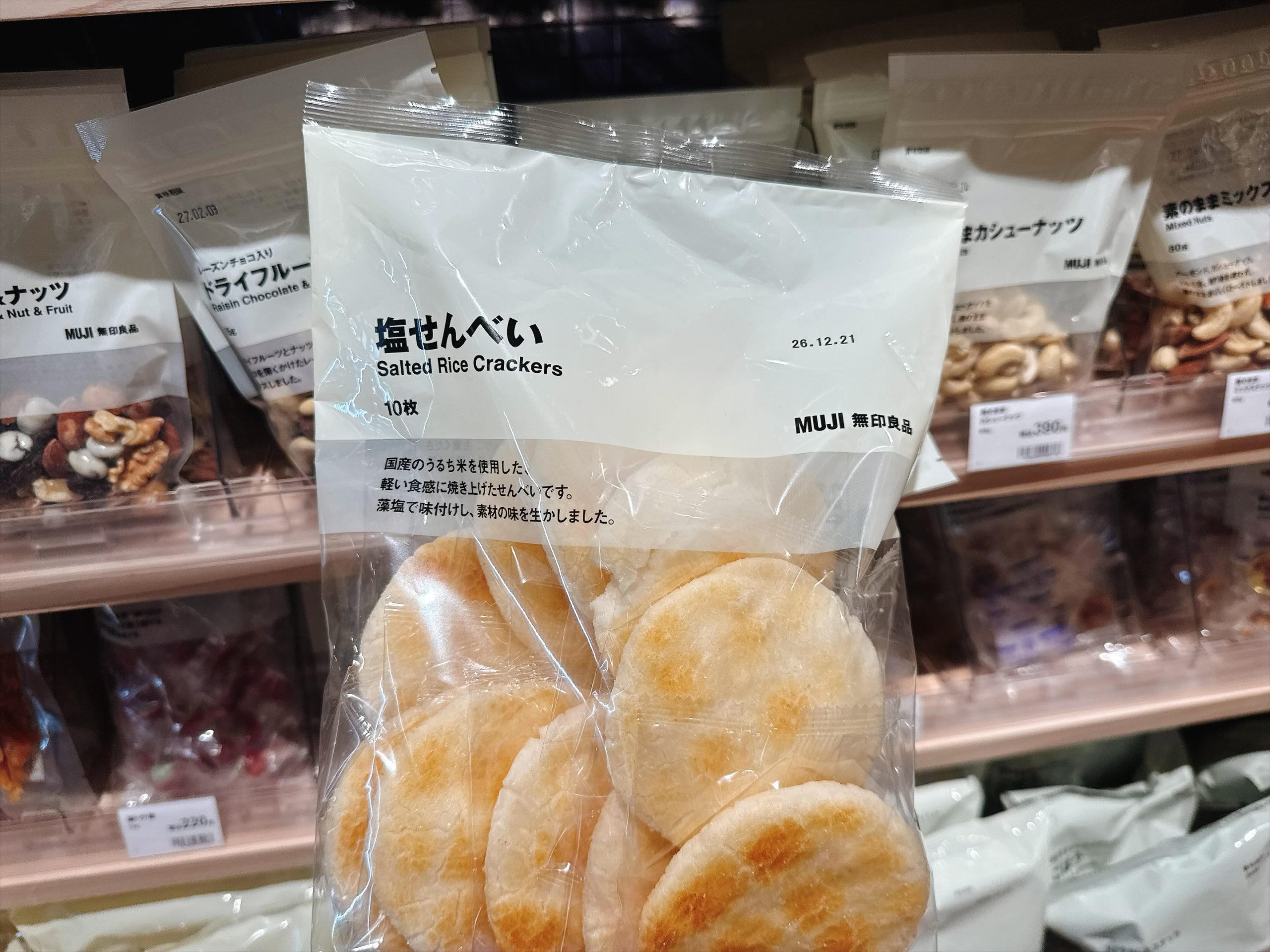
For anyone who doesn’t have a sweet tooth. Senbei are flat, crunchy rice crackers, and this salted version keeps things simple. It’s an everyday Japanese snack rather than a special souvenir, which is exactly why I like it as a gift. Senbei break easily, so pack them in the middle of your suitcase, surrounded by clothes.
Price: ¥450
🎁 Giftable: ★★★★★
🧳 Easy to pack: ★☆☆☆☆
🇯🇵 Japan-only advantage: High
Seaweed Rice Crackers (海苔あられ)
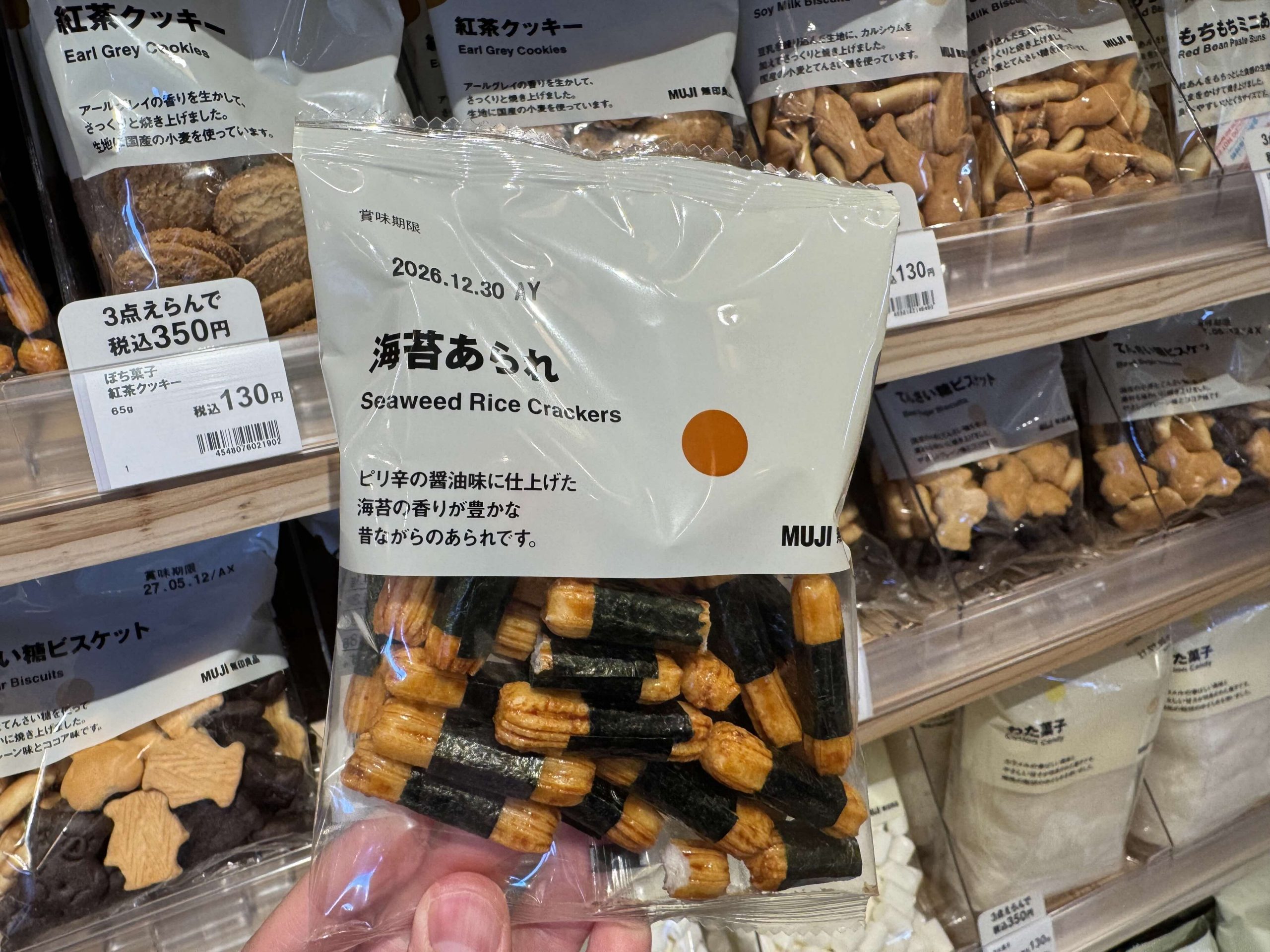
At ¥130, this is one of the cheapest things in this guide. Arare are bite-sized rice crackers, much smaller than senbei, and these are flavored with seaweed (nori). If you need small gifts for a lot of people, a few bags go a long way. They’re light but fragile, so give them the same careful spot in your suitcase.
Price: ¥130
🎁 Giftable: ★★★★★
🧳 Easy to pack: ★★★★☆
🇯🇵 Japan-only advantage: Medium
White Chocolate Coated Strawberries (不揃い ホワイトチョコがけいちご)
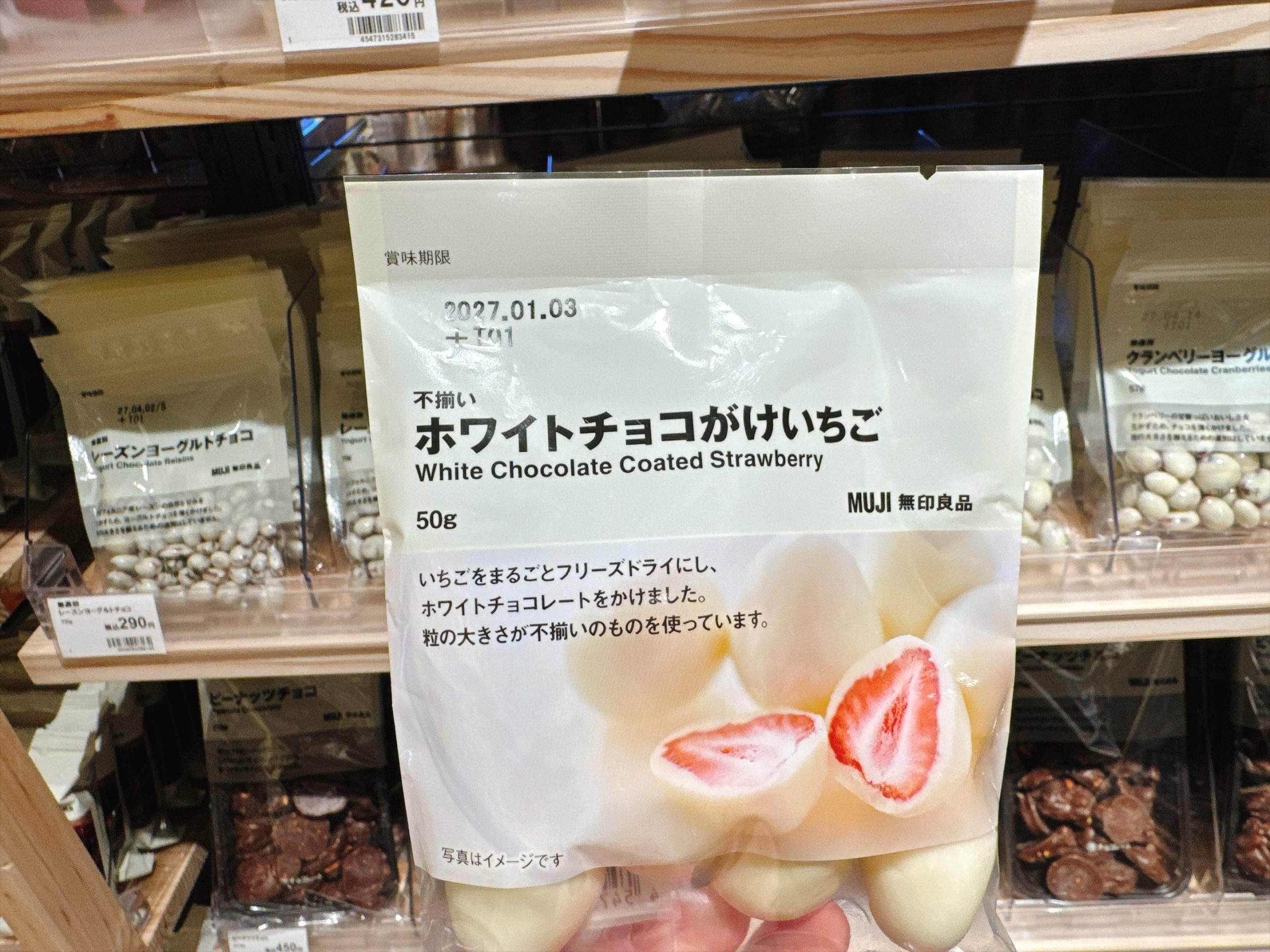
For years, I’ve seen these displayed prominently in MUJI stores, and they’re one of the most recognizable MUJI snacks in Japan. Like the baumkuchen, they’re labeled 不揃い, so the strawberry pieces come in uneven shapes. Chocolate doesn’t like heat, so keep them out of the sun in summer, and grab them when you see them, since availability can change.
Price: ¥420
🎁 Giftable: ★★★★★
🧳 Easy to pack: ★★★★★
🇯🇵 Japan-only advantage: Medium
Skincare
Skincare has long been one of MUJI’s signature categories, and it’s consistently popular in Japan. In fact, the five best-selling personal care items in MUJI’s online ranking for January to June 2026 all appear below. One rule for all of them: liquids over the carry-on limit go in your checked bag.
Booster Serum (発酵導入美容液)
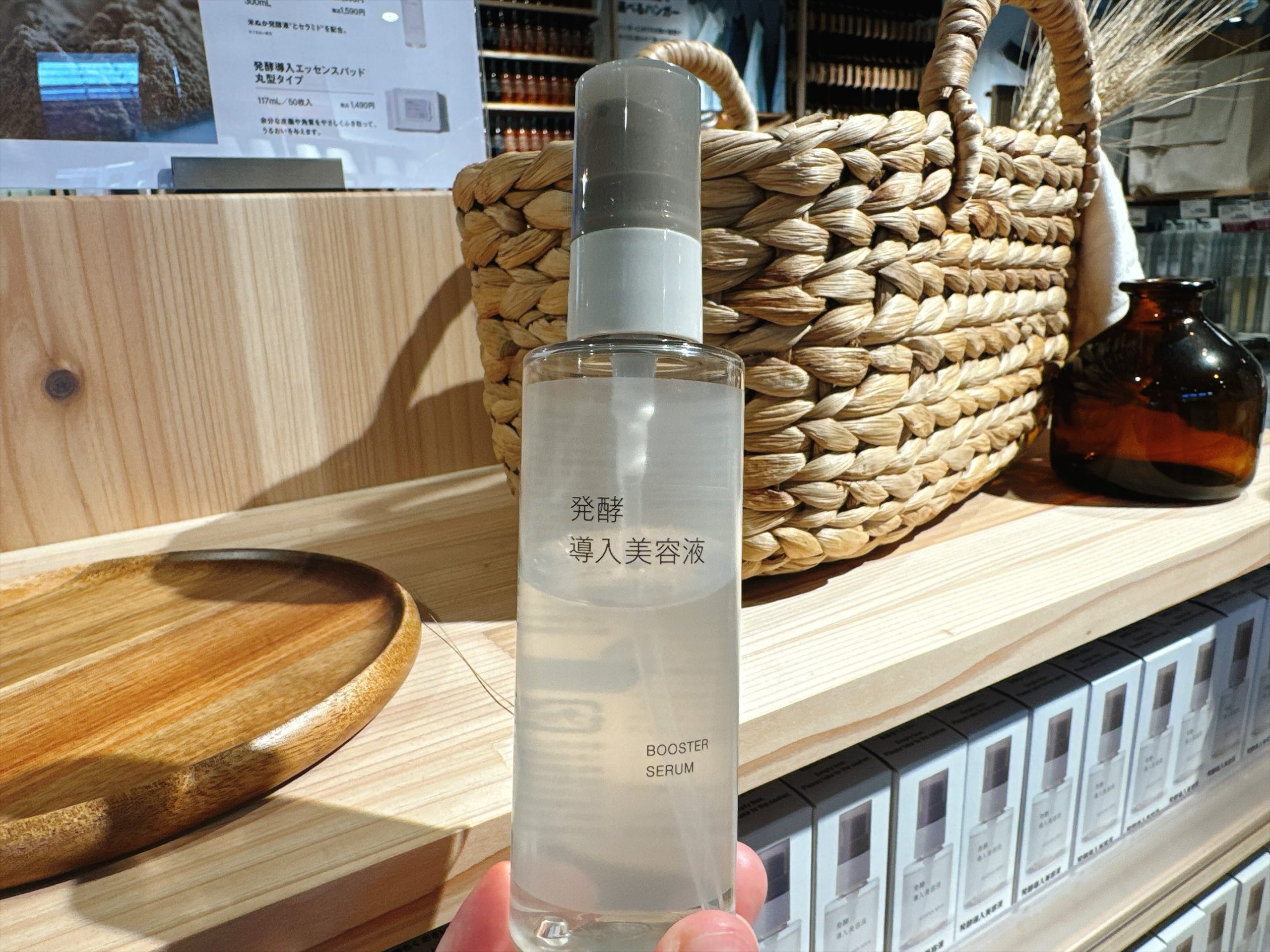
This is MUJI Japan’s skincare headliner. It was the top skincare item in MUJI’s 2025 ranking, and so far in 2026 it holds the top two spots in the online personal care ranking: the large size first, the regular size second. 導入 (donyu) means “introduction.” You use it right after cleansing, before toner. It contains no water and is made with more than 65% fermented rice bran liquid.
If you’re trying it for the first time, the 50mL size is easier to pack.
Price: ¥1,990 (50mL)
Large size also available
🎁 Giftable: ★★★☆☆
🧳 Easy to pack: ★★★★☆
🇯🇵 Japan-only advantage: Low
Booster Essence Lotion (発酵導入化粧液)
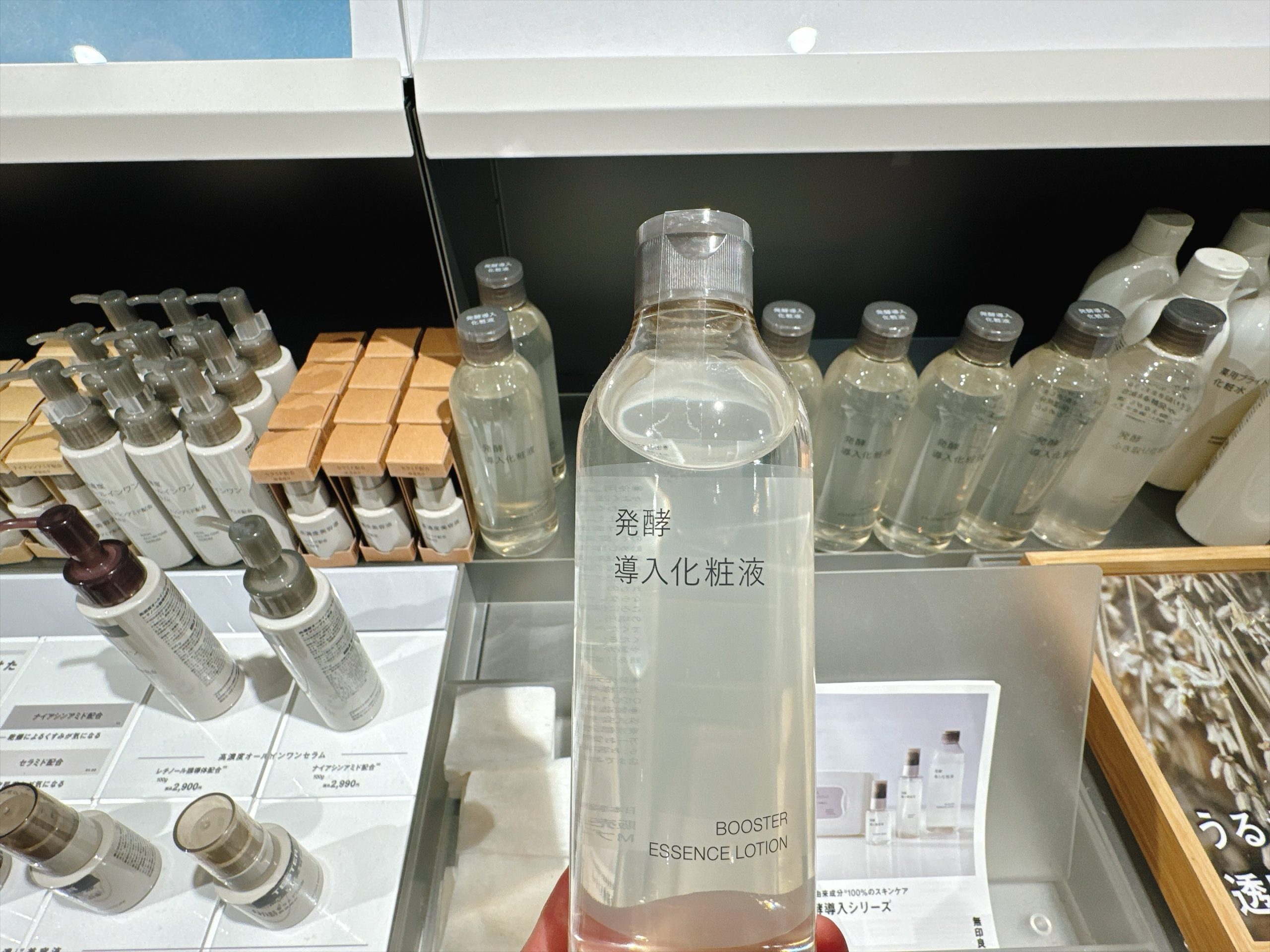
This toner-style lotion belongs to the same fermented series and rounds out that top five. It’s for people who want the matching routine. The catch is weight: it comes in a big bottle, so think about your luggage before buying two.
Price: ¥1,590
🎁 Giftable: ★★★☆☆
🧳 Easy to pack: ★★★☆☆
🇯🇵 Japan-only advantage: Low
Natural Water-Based Body Mist (肌の天然水 全身用ミスト)
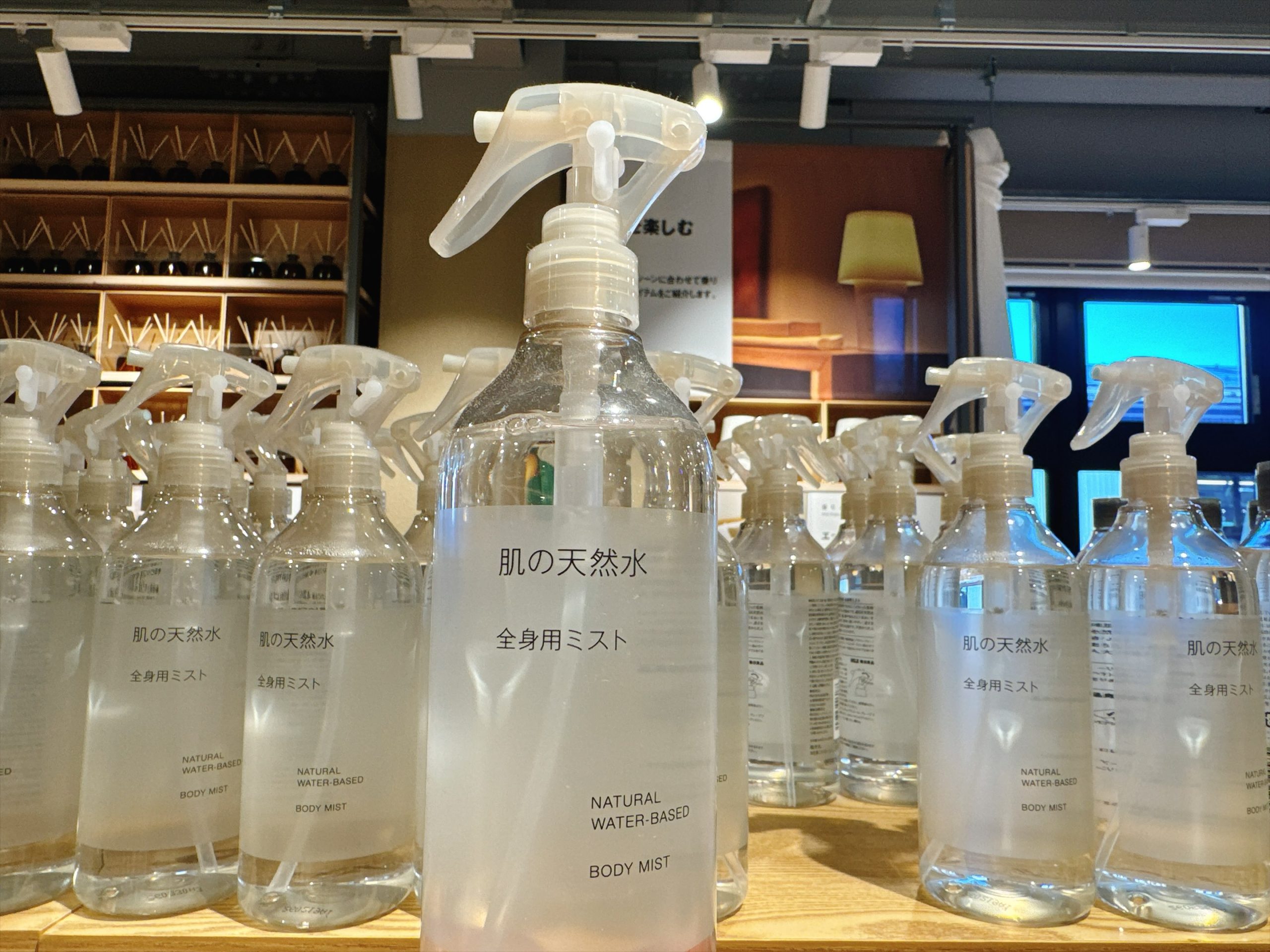
A gentle mist-type toner, and number three in that same personal care ranking. According to MUJI, it’s made entirely from naturally derived ingredients with natural water from Kamaishi, and it adds moisture to your hair, face and body. It also works upside down, so you can reach your back. It’s fragrance-free and alcohol-free, and MUJI says it’s suitable for both kids and adults. It’s one to buy early in your trip and use as you go, rather than pack home.
Price: ¥690
🎁 Giftable: ★★★★☆
🧳 Easy to pack: ★★★☆☆
🇯🇵 Japan-only advantage: High
Mild Gel Cleansing, Large (マイルドジェルクレンジング 大容量)
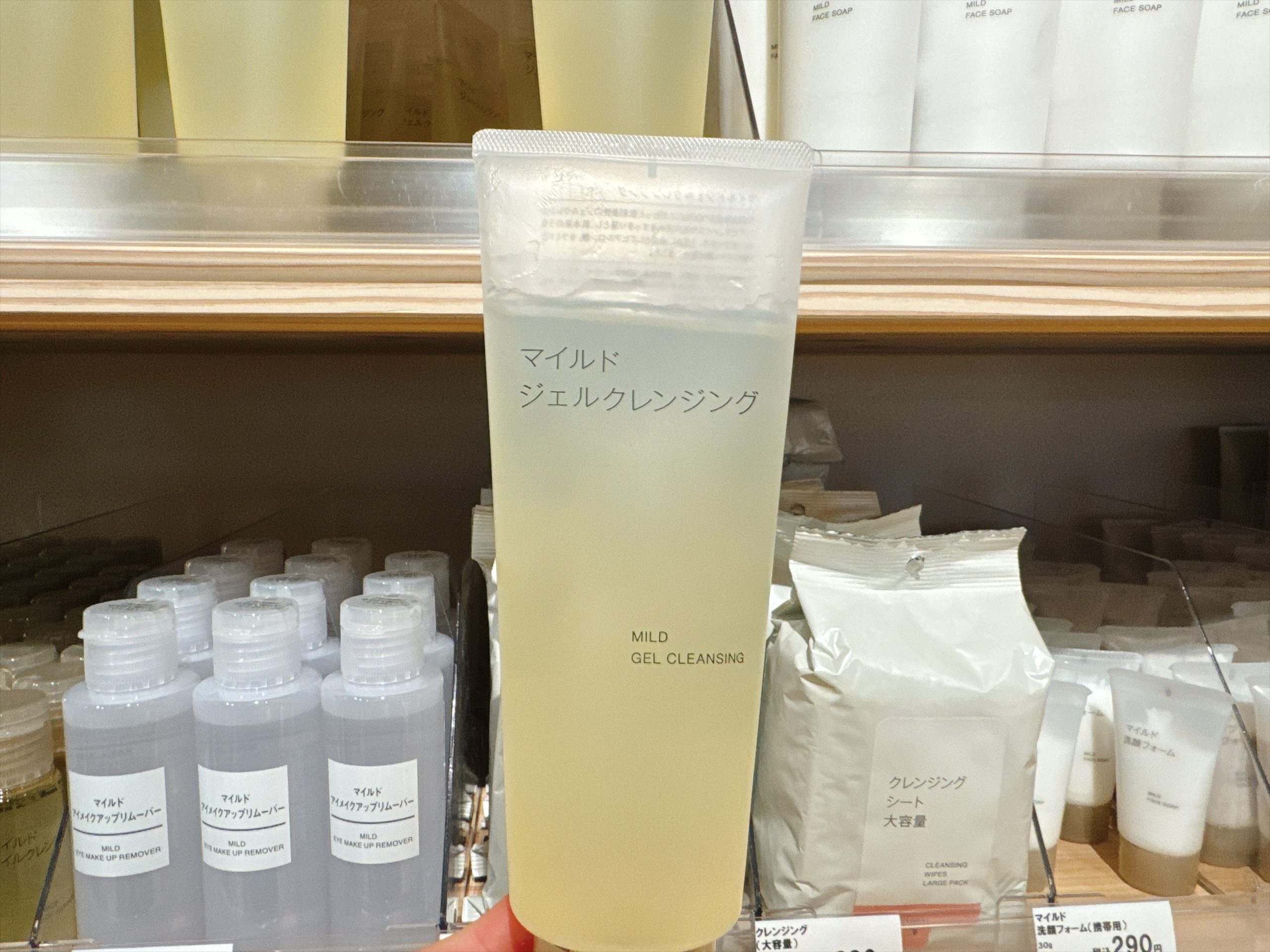
A gentle gel makeup remover, sitting at number four on the list. The large 220g tube is the better value if you use a lot, but there’s also a 30g travel size if you just want to try it.
Price: ¥850 (220g)
🎁 Giftable: ★★★☆☆
🧳 Easy to pack: ★★★☆☆
🇯🇵 Japan-only advantage: Medium
Lip Essence, Pink (リップエッセンス ピンク)
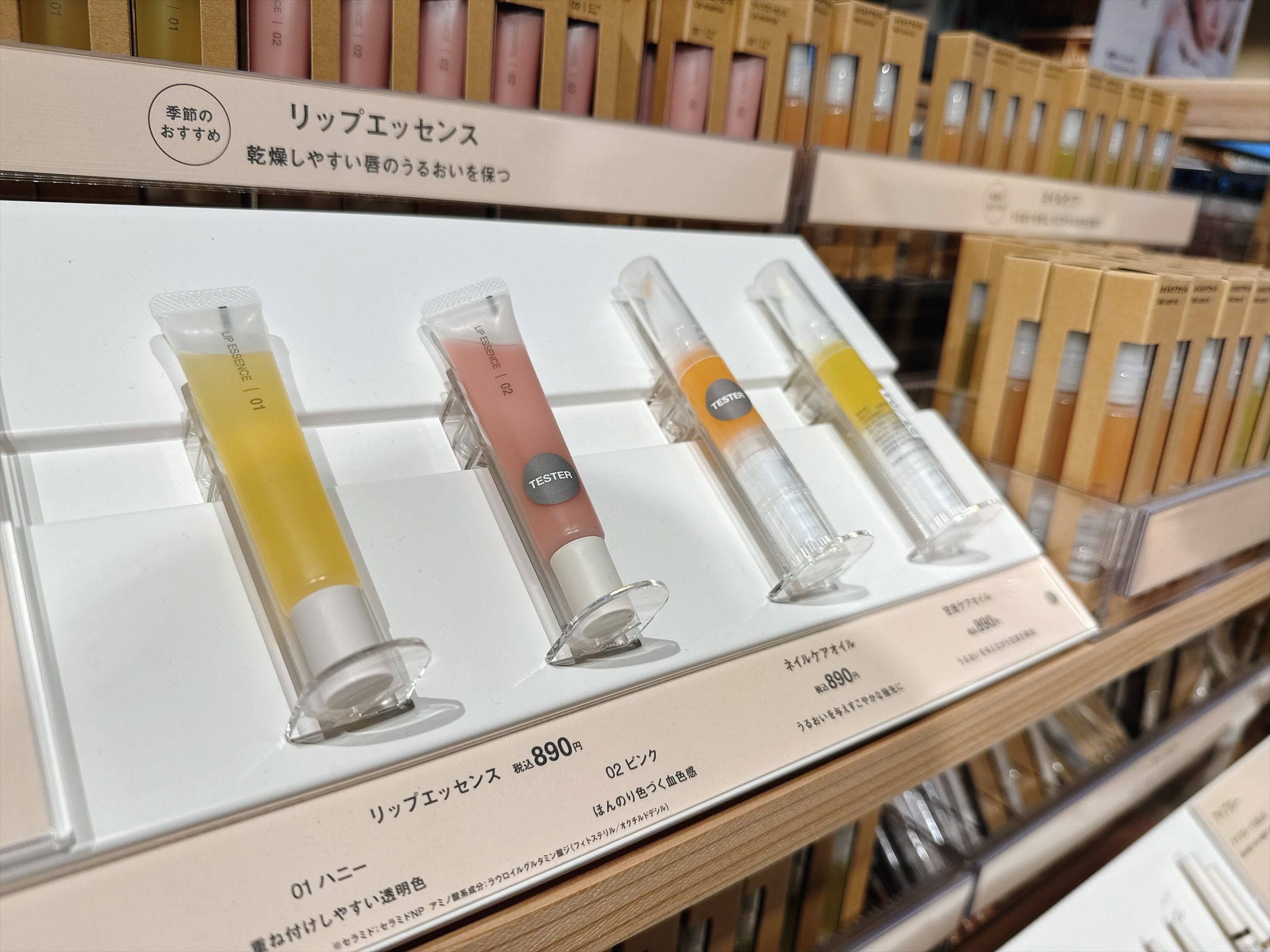
Small, inexpensive and easy to give away, this was ranked second in a 2025 list of favorite products chosen by MUJI’s own senior health and beauty advisors. It’s a good pick if you want something to give a friend that isn’t food.
Price: ¥890
🎁 Giftable: ★★★☆☆
🧳 Easy to pack: ★★★★★
🇯🇵 Japan-only advantage: High
Cleansing & Refreshing Mask (洗顔もできるすっきりマスク)
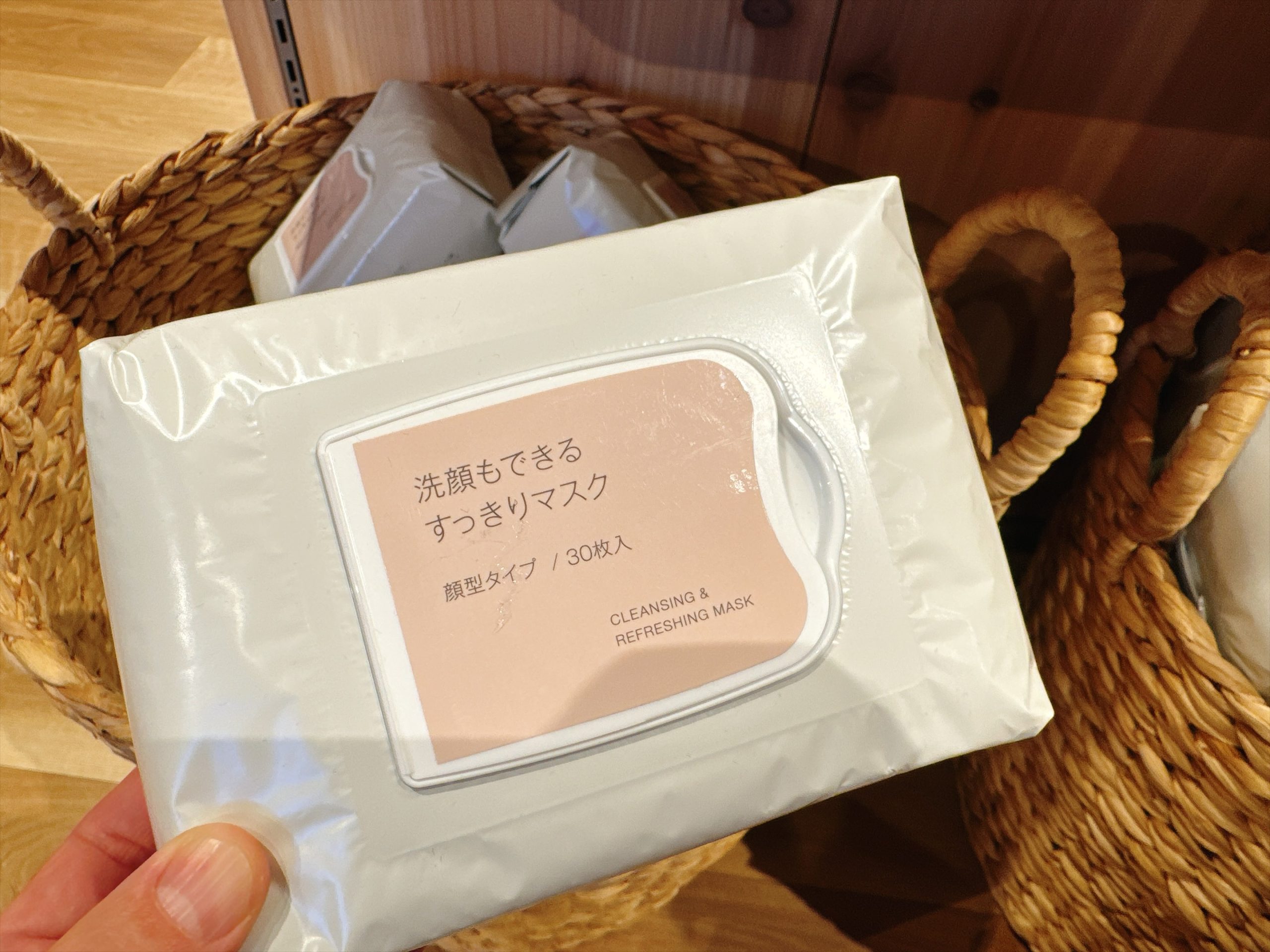
A sheet mask for busy mornings that rolls face washing and moisturizing into one step. According to MUJI, you lay a sheet on your face for about a minute, then fold it and use it to gently wipe your skin, so there’s no separate face wash needed. A pack holds 30 sheets in a box about 11 by 15 by 6.8cm, which makes it a better fit for a longer trip than a weekend away.
Price: ¥1,290 (30 sheets)
🎁 Giftable: ★★☆☆☆
🧳 Easy to pack: ★★★☆☆
🇯🇵 Japan-only advantage: High
Several of these, including the Booster Serum, Body Mist, large Mild Gel Cleansing and Cleansing Mask, are also listed on MUJI’s site as available at Lawson convenience stores. Not every Lawson carries them, but it’s worth a look if you run out late at night.
Japanese Kitchen Items
Silicone Multipurpose Band (シリコーン マルチバンド)
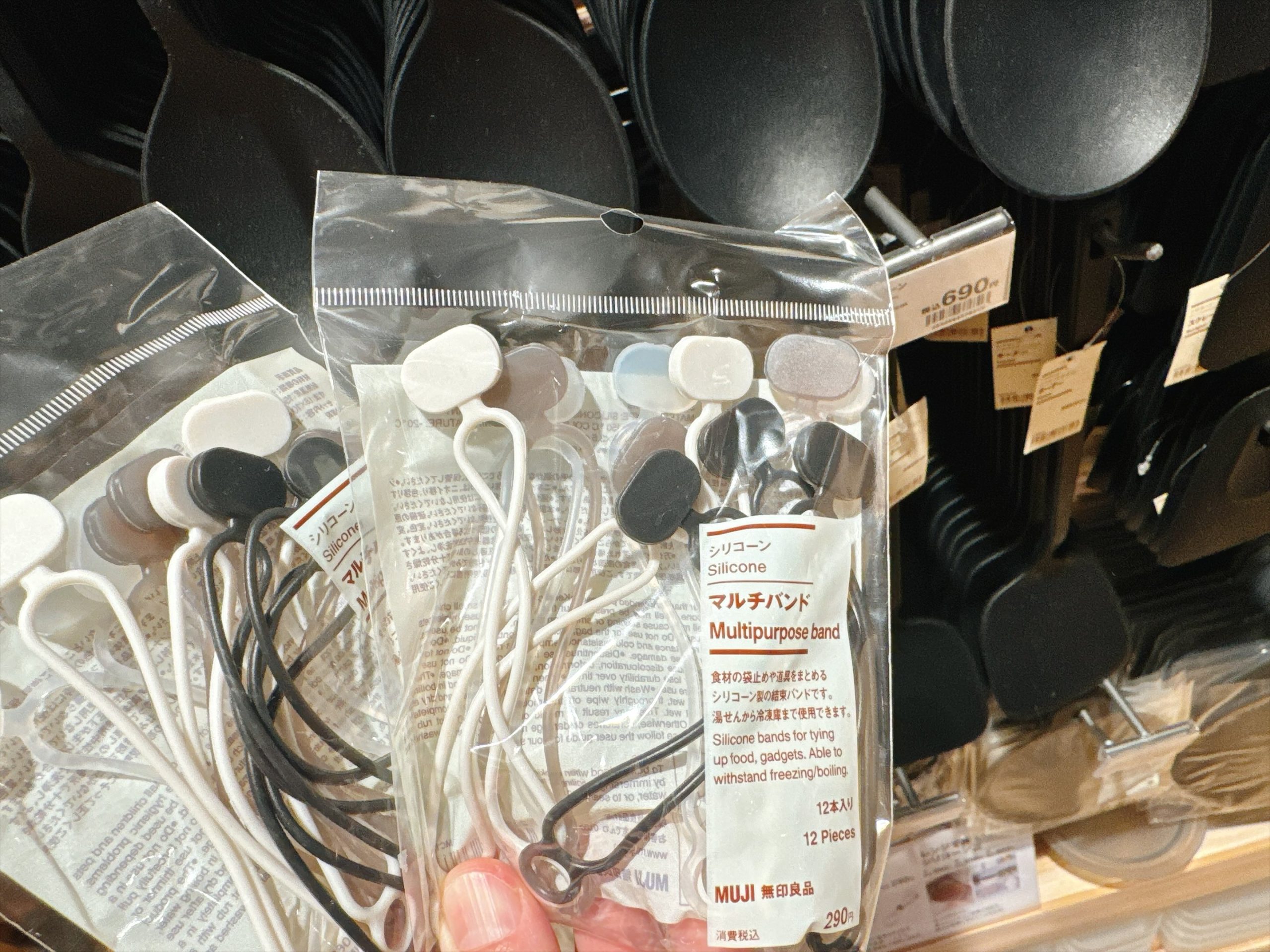
Of everything MUJI sold online in Japan from January to June 2026, this was number one. It’s a stretchy silicone band. Reviewers use it to close bags of frozen food, bundle cables and hold spinach together while boiling. On a trip, it works just as well for tidying charging cables. Few things you can buy at MUJI are this cheap and this useful.
Price: ¥290
🎁 Giftable: ★★☆☆☆
🧳 Easy to pack: ★★★★★
🇯🇵 Japan-only advantage: Low
Bamboo Steamer (竹材 蒸篭)
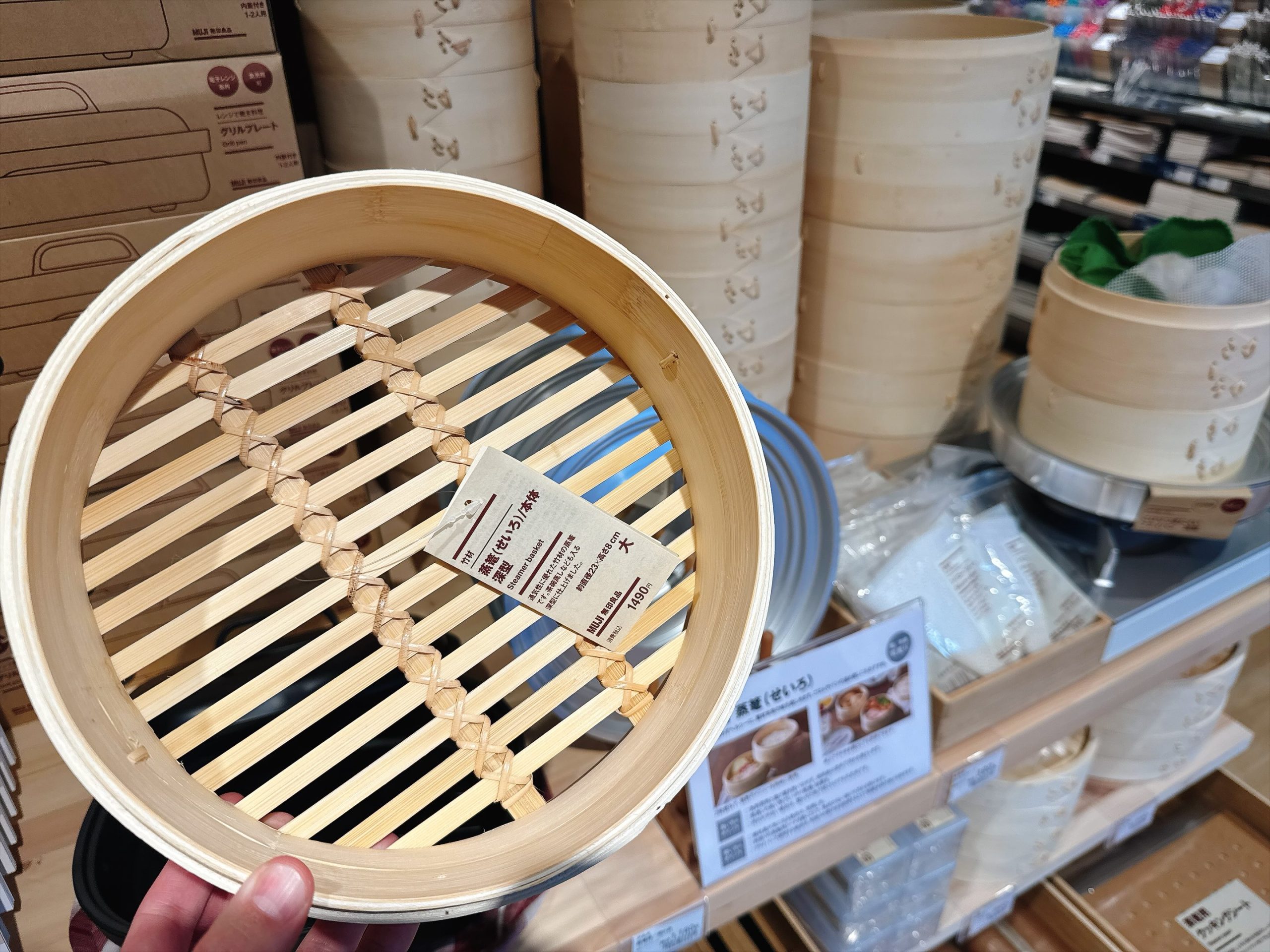
Seiro, or bamboo steamers, have been one of MUJI Japan’s most in-demand kitchen items lately. From late 2025 through spring 2026, store after store posted announcements about getting them in or restocking them. The bamboo absorbs some of the steam, so water doesn’t drip onto the food as much.
The body and lid are sold separately, so don’t forget the lid. The large body is about 23cm across and 8cm tall, so it takes up real space in a suitcase. If that’s too big, there’s a smaller 18cm version (body ¥1,090, lid ¥690).
Price: ¥1,490 (large body) + ¥890 (large lid) = ¥2,380
🎁 Giftable: ★★★☆☆
🧳 Easy to pack: ★★☆☆☆
🇯🇵 Japan-only advantage: Medium
Wooden Lacquered Lunchbox (木製 漆塗り弁当箱)
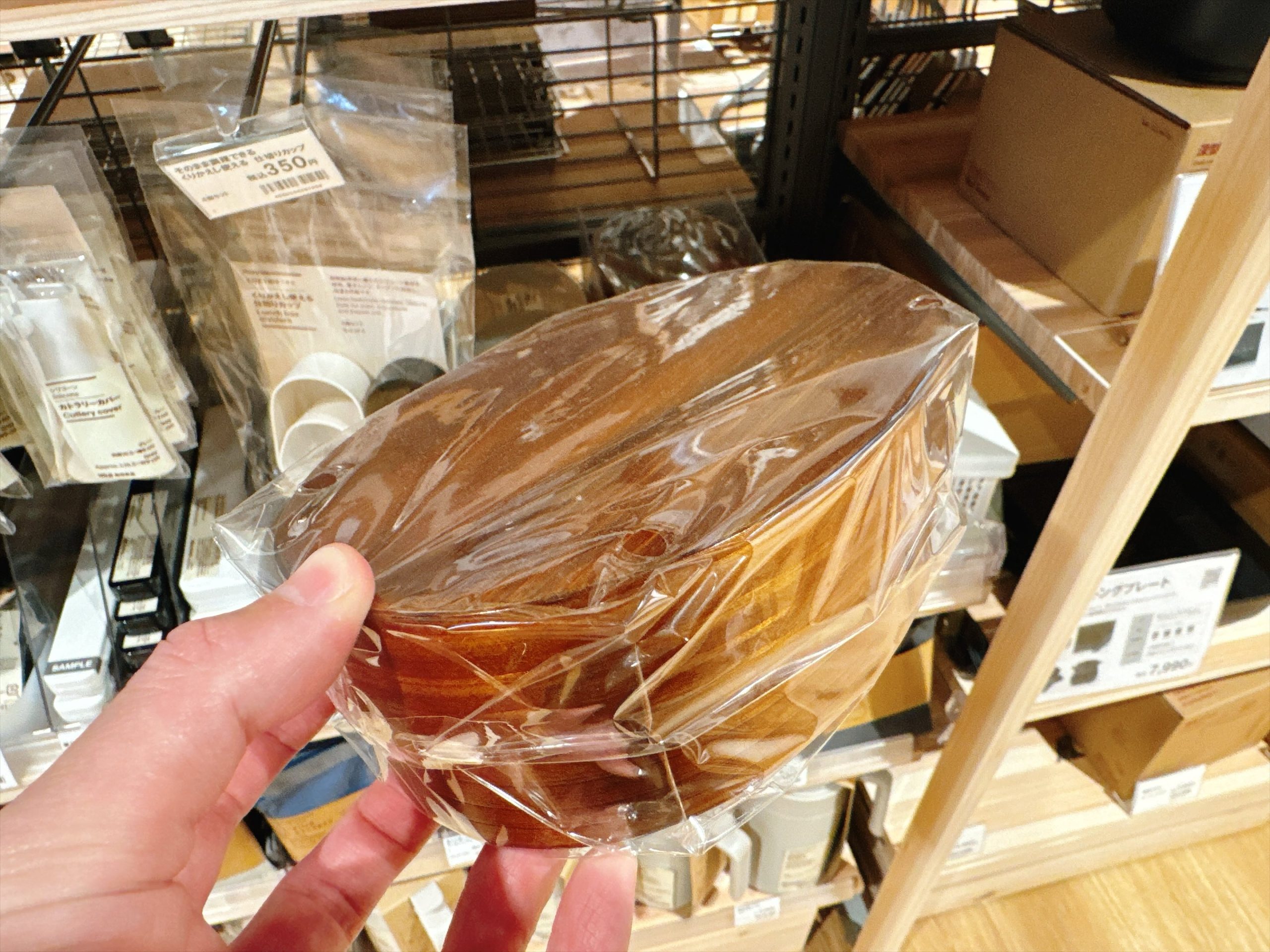
An oval bento box made of Japanese cedar and finished with urushi lacquer. It’s 5.5cm tall, so it holds more than it looks. Lacquerware needs a little more care than plastic, but this one is made for everyday lunches, not just for display.
Price: ¥3,900
🎁 Giftable: ★★★★★
🧳 Easy to pack: ★★★★☆
🇯🇵 Japan-only advantage: Low
Sakura Chopsticks, Octagonal (和桜 八角箸)
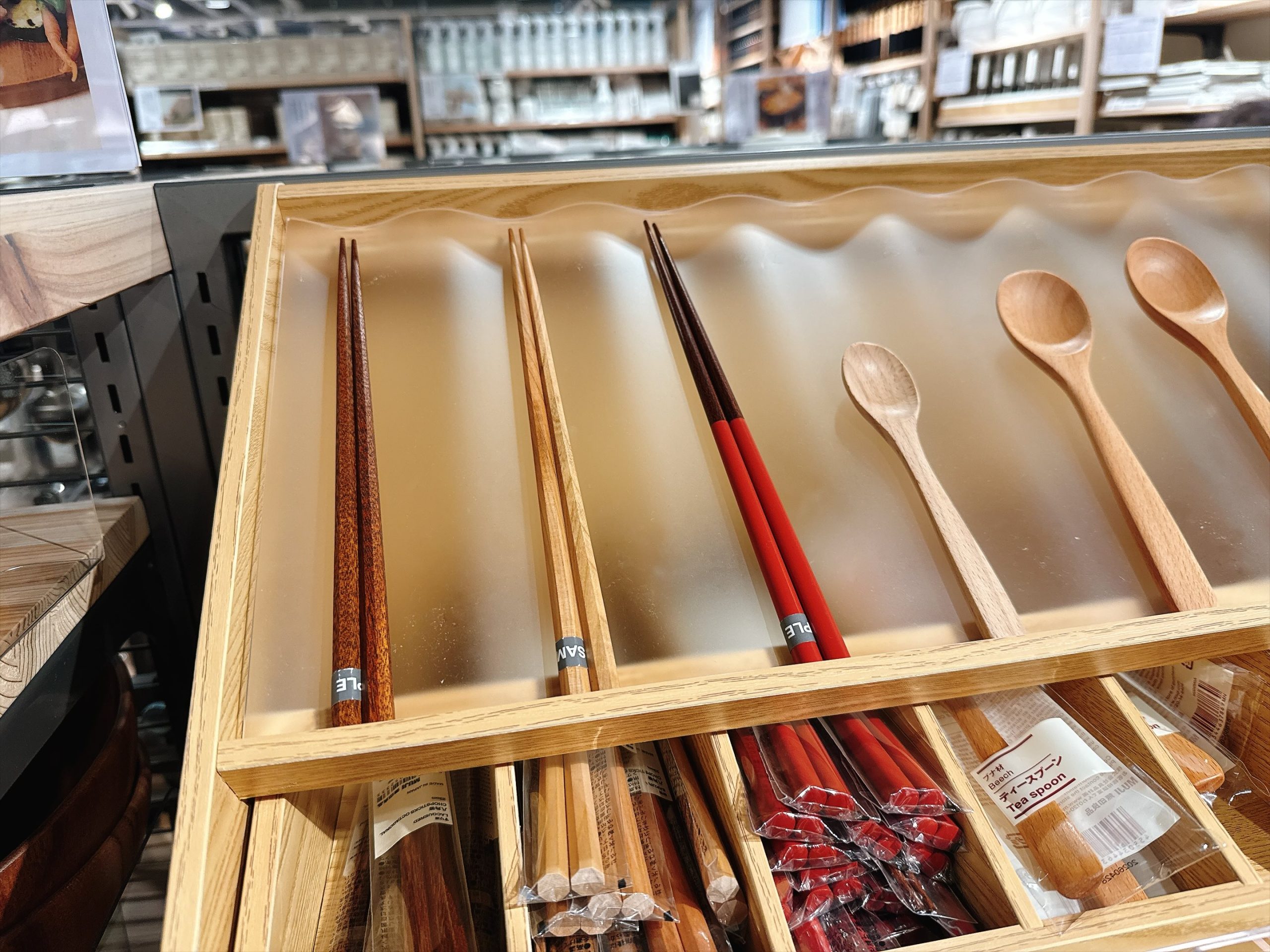
Made of Japanese cherry wood (wazakura) with an eight-sided shape. Chopsticks are light, slim and hard to break, which makes them about as easy a souvenir as it gets.
Price: ¥790
🎁 Giftable: ★★★★★
🧳 Easy to pack: ★★★★★
🇯🇵 Japan-only advantage: Low
Travel Gear to Buy Early
Unlike the food and skincare above, buy these at the start of your trip.
Dry Shampoo (水のいらないシャンプー)
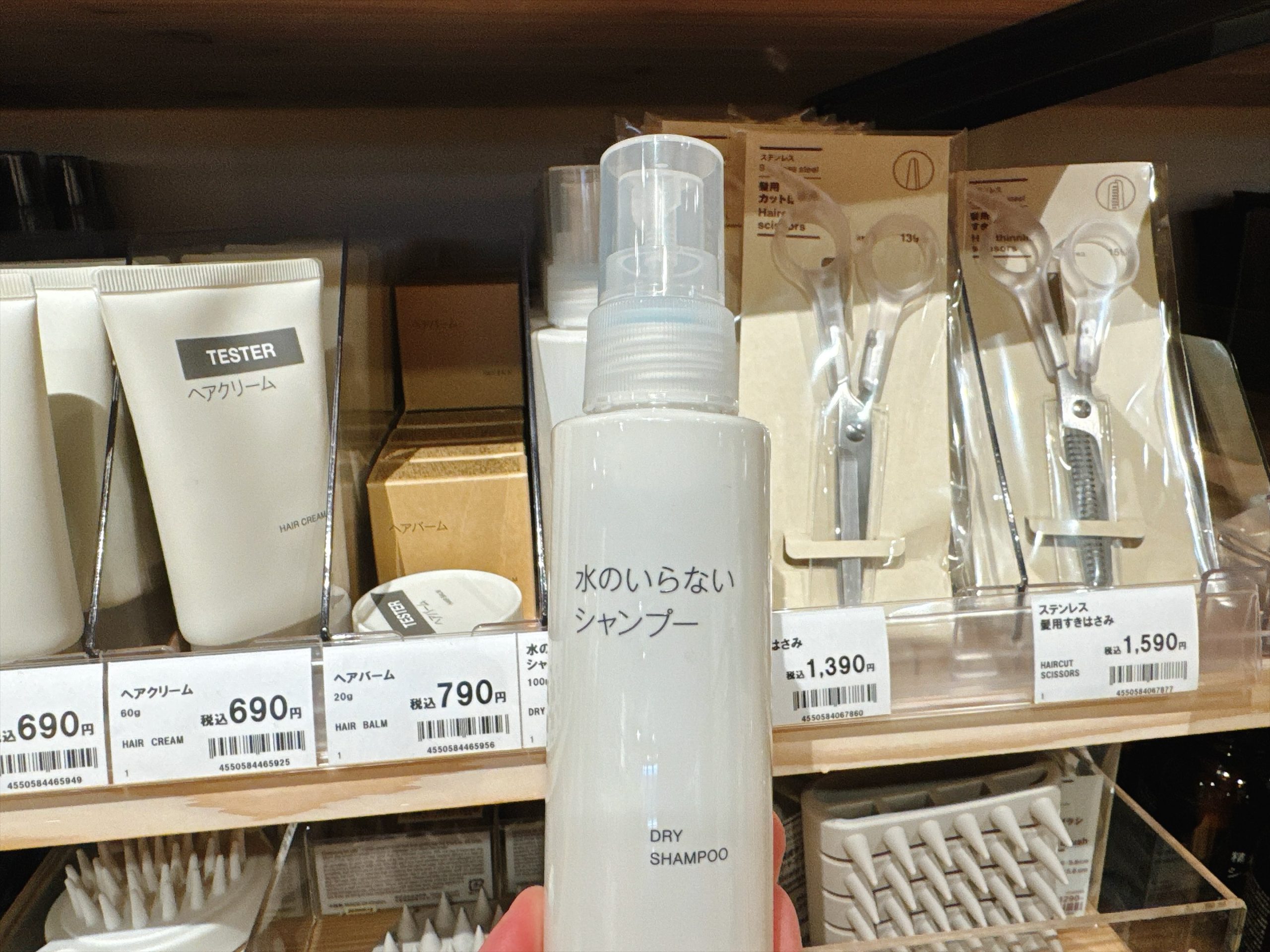
A no-rinse spray shampoo. In Japan, MUJI presents it as something for emergency kits and for hot, sweaty days, and it’s handy on long travel days or overnight buses too. Check your airline’s rules for sprays before putting it in your carry-on.
Price: ¥890
🎁 Giftable: ★★☆☆☆
🧳 Easy to pack: ★★★★☆
🇯🇵 Japan-only advantage: Medium
Silicone Identification Band S (シリコーン識別バンド)
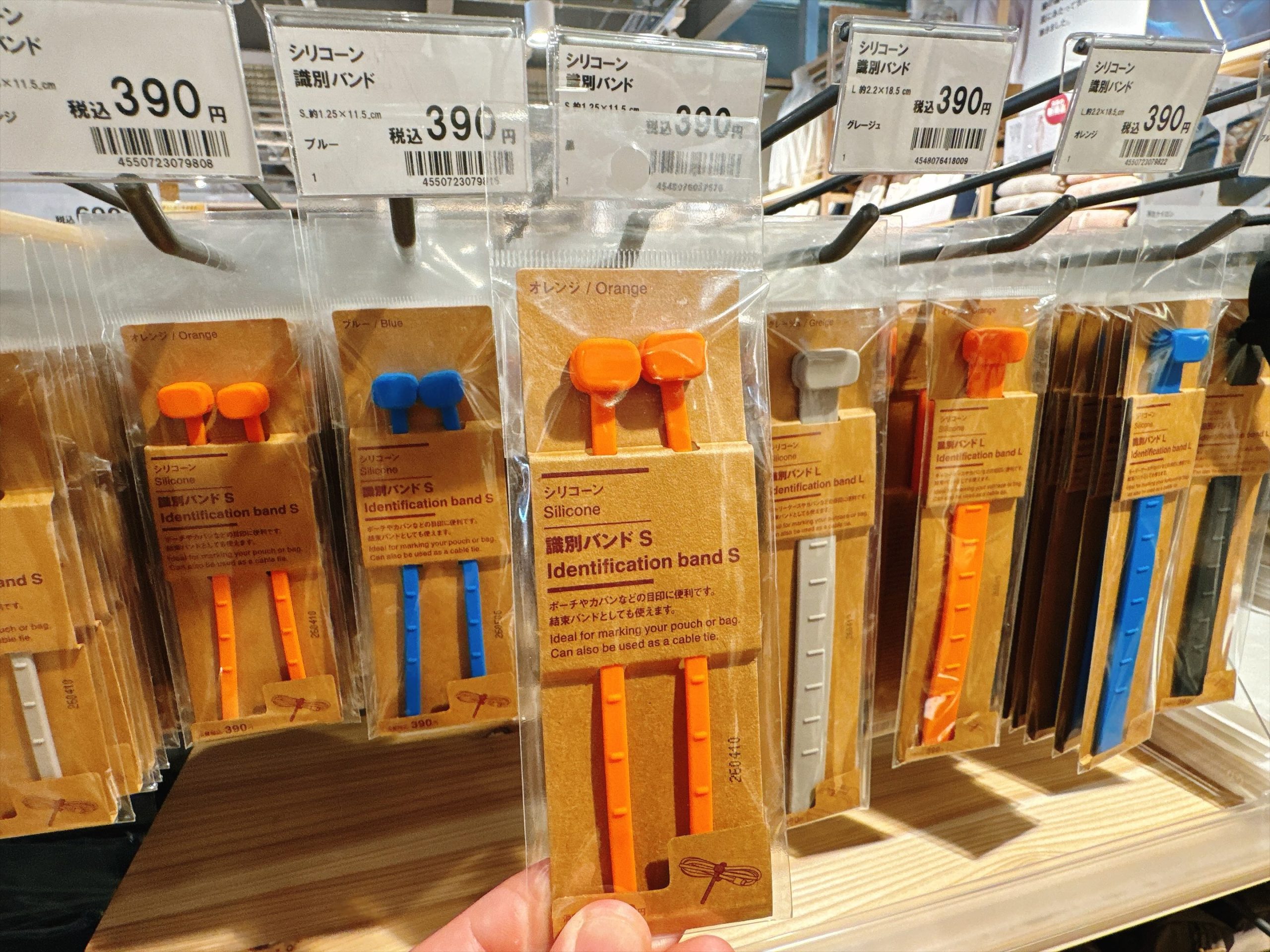
A silicone band, in black, gray, orange or blue, that you put on your suitcase handle so you can spot your bag on the baggage carousel. At an airport full of similar black and silver cases, it helps.
Price: ¥390
🎁 Giftable: ★★☆☆☆
🧳 Easy to pack: ★★★★★
🇯🇵 Japan-only advantage: High
Recycled Polyester Gusset Compression Case (再生ポリエステル仕分けケース 圧縮タイプ)
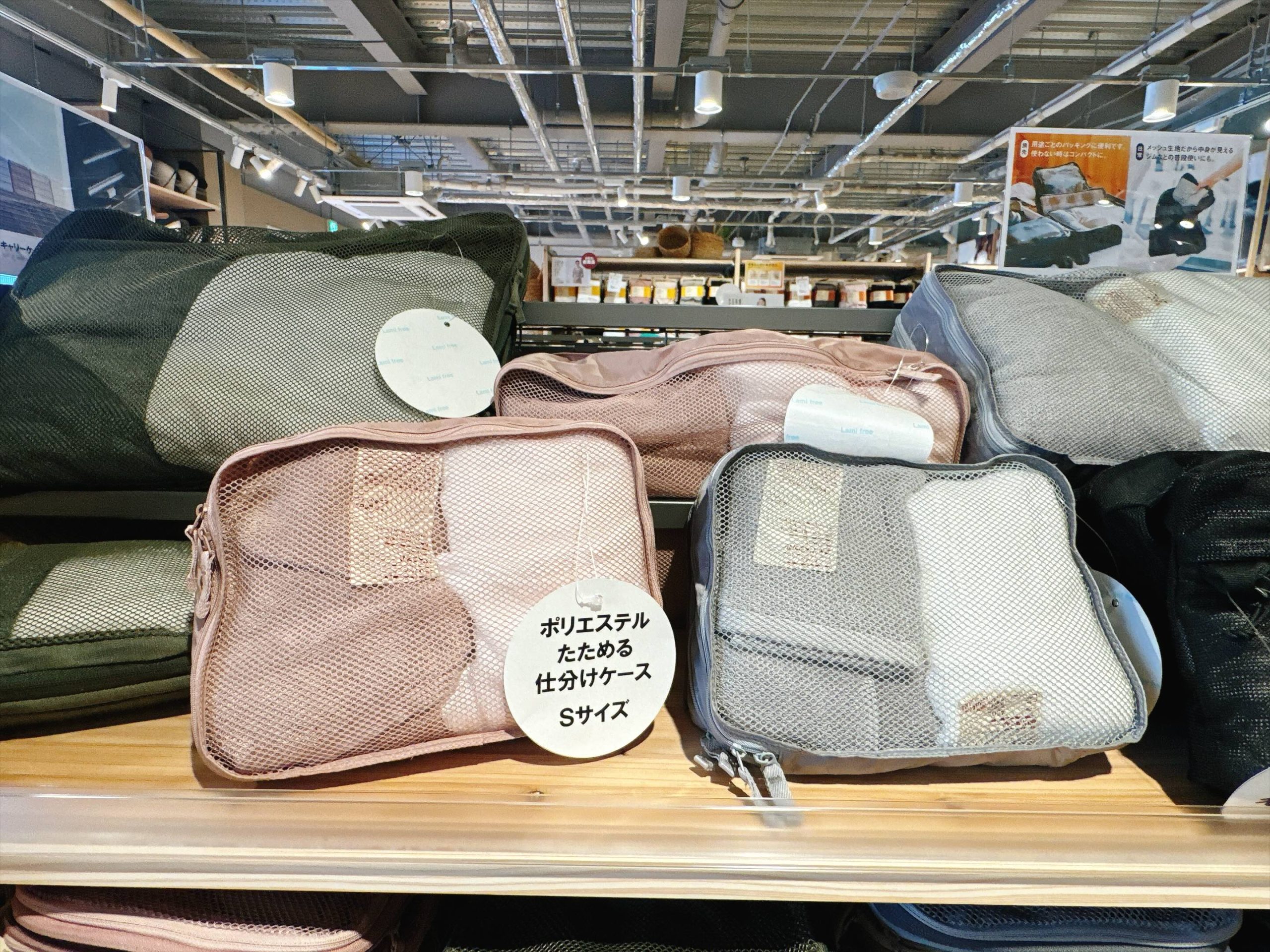
A packing case made of recycled polyester that compresses your clothes. It’s the most useful thing on this list on your last day, when the souvenirs need room.
Price: ¥1,690
🎁 Giftable: ★★☆☆☆
🧳 Easy to pack: ★★★★★
🇯🇵 Japan-only advantage: Low
Passport Case with Pocket (ポリエステル パスポートケース クリアポケット付)
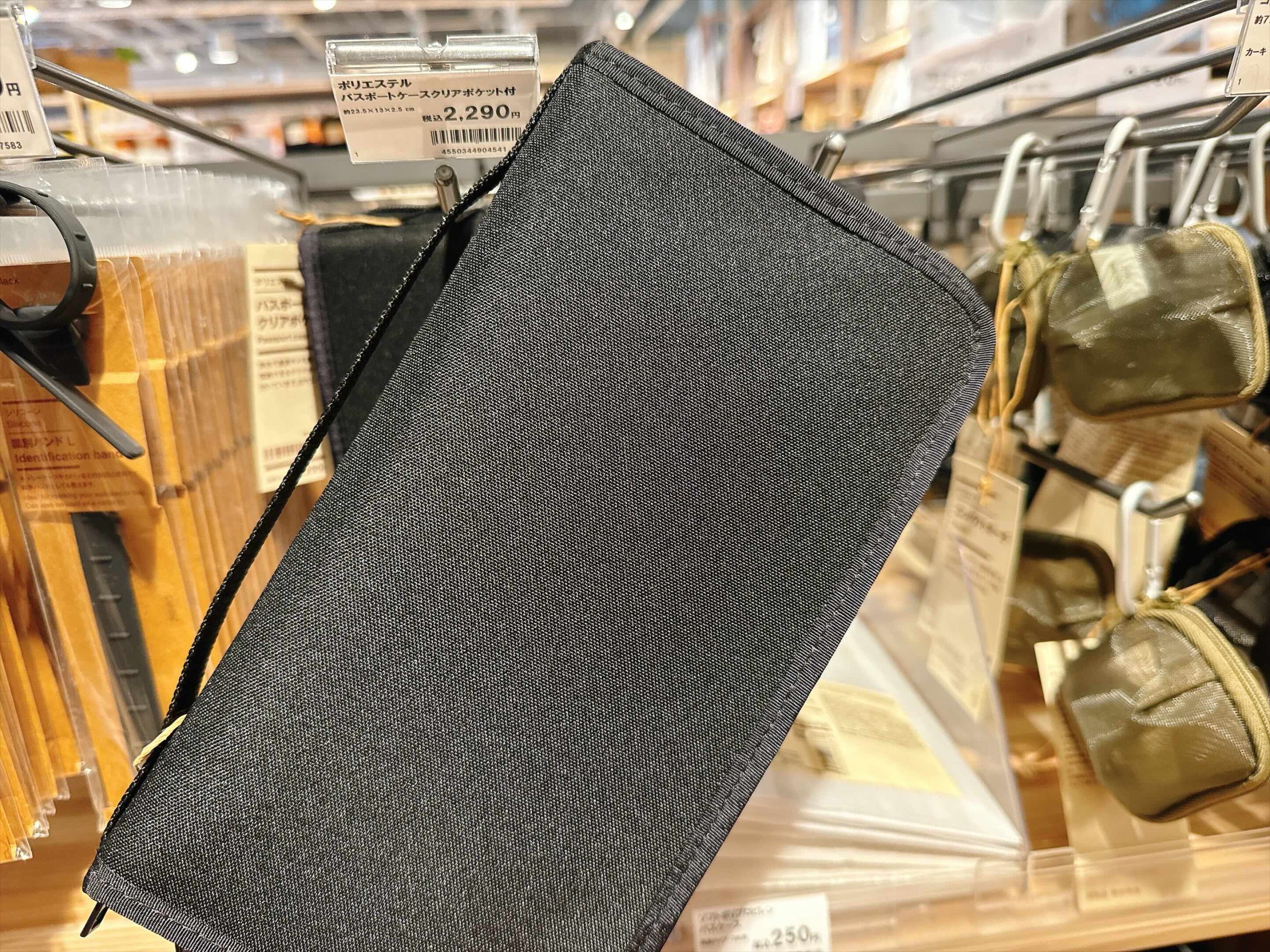
Under the new tax-free system, you show your passport at the airport to get your refund. A case with a clear pocket keeps your passport and receipts in one place until then.
Price: ¥2,290
🎁 Giftable: ★★☆☆☆
🧳 Easy to pack: ★★★★★
🇯🇵 Japan-only advantage: Low
Also Worth a Look: Stationery and Innerwear
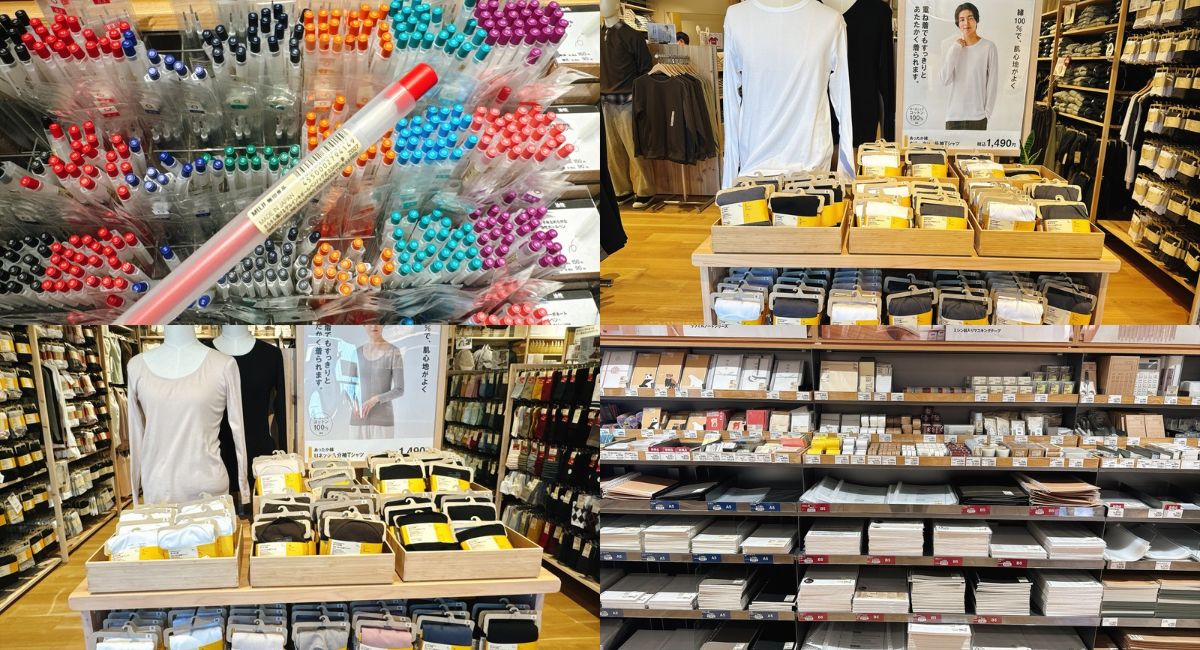
Food may be the quickest way into Japanese MUJI, but two other categories are worth a few extra minutes if you’re already in a larger store.
MUJI’s stationery shows the brand’s no-frills design at its most practical. Pens, notebooks and small desk items are simple, inexpensive and light, so they’re easy to buy in bulk and easy to pack. Because they cost so little, they also work well as small add-on gifts.
Innerwear is the other category MUJI is known for in Japan, and it’s popular in both summer and winter. The lineup changes with the seasons, so what you’ll find depends on when you visit: lighter, more breathable pieces in the warmer months, and warmer layers when it gets cold. Whatever the season, the quality is consistently high. Japanese sizes often run small, so check the size chart on the package before you buy.
Here are three easy places to start:
- Gel Ink Ballpoint Pen, Knock Type (さらさら描けるゲルインキボールペン ノック式): MUJI’s best-selling stationery item in 2025, at ¥120. Buy a few colors.
- Double-Ring Notebook, A5 (植林木ペーパー ダブルリングノート): A plain notebook made from plantation-grown wood paper, at ¥150.
- Right-Angle Socks (足なり直角靴下): The heel is knitted at a 90-degree angle to match your foot, so the socks stay in place. Single pairs start around ¥390.
Where to Shop
MUJI Ginza, the world flagship
If you only visit one MUJI in Japan, make it the Ginza flagship (3-3-5 Ginza, Chuo City), about a 3-minute walk from Exit B4 of Ginza Station. The store runs from the basement to the 6th floor, with MUJI Hotel Ginza above. The 4th floor has a large travel section where you can try suitcases. The basement restaurant, MUJI Diner, is useful if you want to eat while you shop.
Ginza isn’t the only big MUJI in town. For more large stores across the city, see our guide to the largest MUJI stores in Tokyo.
MUJI 500, near stations
Stores with “500” in the name are compact shops in and around train stations. Despite the name, they’re not ¥500 shops. About 70% of the items are ¥500 or less, focusing on snacks, ready-to-eat meals, skincare and everyday basics. For most of the food and skincare in this guide, a MUJI 500 is enough.
Lawson convenience stores
Around 250 MUJI items, including skincare, socks, stationery and some curries and snacks, are sold at Lawson. The selection varies by store.
The world’s largest MUJI
MUJI Aeon Mall Kashihara in Nara Prefecture has 8,201 square meters of sales space, the largest of any MUJI. It’s mainly reached by car or bus, so it’s for MUJI fans with a free day in the Kansai region.
Tax-free MUJI stores
Not every MUJI store handles tax-free shopping, so if you’re planning a bigger haul, head to one that does. Here are some of the main tax-free stores, starting with Tokyo.
Tokyo
- Ginza (銀座): The world flagship, at 3-3-5 Ginza.
- Shinjuku-dori (新宿通り): B1F to 3F of the Isamiya Building, on Shinjuku-dori in Shinjuku 3-chome.
- Shibuya Koen-dori (渋谷公園通り): A street-front store in Udagawa-cho, Shibuya.
- Seibu Ikebukuro (池袋西武): 1F to 2F of the Seibu Ikebukuro annex.
- Asakusa ROX (浅草ROX): ROX 3F, a short walk from Senso-ji.
- MUJI to GO KITTE Marunouchi (KITTE丸の内): JP Tower 3F, right by Tokyo Station.
- Tokyo Ariake (東京有明): A three-floor store in Ariake, near Odaiba.
Other cities
- Kyoto: Kyoto Porta (京都ポルタ), at Kyoto Station.
- Osaka: Grand Front Osaka (グランフロント大阪), North Building 2F to 4F, by Osaka Station.
- Sapporo: Sapporo Stellar Place (札幌ステラプレイス), East 6F, at Sapporo Station.
- Fukuoka: Canal City Hakata (キャナルシティ博多), North Building 3F to 4F.
Heading to Osaka? Our guide to large MUJI stores in Osaka covers more options around Umeda and Namba.
Tax-free stores are spread across the country, from Hokkaido to Okinawa, including the world’s largest MUJI in Kashihara. For the full list, see MUJI’s tax-free store list (in Japanese). The list changes from time to time, so check it before you go.
A tip for finding things
Screenshot the Japanese names in this guide. Showing staff the Japanese name on your phone is the fastest way to find an item.
Is There a MUJI Sale? Muji Week vs. Tax-Free
The best-known MUJI sale in Japan is 無印良品週間 (Muji Week). For about 11 days at a time, MUJI members get 10% off almost everything, both in stores and on MUJI’s Japanese online store.
When Muji Week happens
Since 2023, Muji Week has usually been held twice a year: once in March, and once from late October into early November. In 2026, the spring edition ran from March 20 to 30, and the autumn edition runs from October 23 to November 3. The dates are usually announced only a few days ahead, so if your trip falls in one of those windows, check MUJI’s Japanese website or ask at a store.
How the discount works
To get 10% off, you need to be a MUJI member: install the MUJI app, register with an email address, and show your member barcode at the register. Members of MUJI’s apps or credit cards from other countries aren’t eligible. A few things are also excluded, including mix-and-match items such as socks and MUJI’s small ぽち菓子 (pochi-gashi) snacks.
Why tax-free is usually the better choice for travelers
Here’s the catch: the Muji Week discount can’t be combined with tax-free shopping. You have to choose one, and for most travelers, tax-free makes more sense.
On paper, Muji Week saves a little more. It takes 10% off the tax-included price, while a tax-free refund gives back the consumption tax, which works out to about 9% of the price for most goods and about 7% for food, which is taxed at a lower 8% rate. But MUJI’s membership is designed for people who live in Japan, the sale runs only about 22 days a year, and you’d have to set up the app first. Tax-free, on the other hand, is open to visitors all year round, as long as you spend ¥5,000 or more before tax at one store in a day.
FAQ
Is MUJI cheaper in Japan?
For many items, likely yes, but it depends on the item and the exchange rate. The Cultured Butter Baumkuchen costs about four times as much at MUJI USA as it does in Japan. If there’s something you buy regularly at home, compare the prices yourself.
Can I take MUJI food home?
Sealed snacks without meat are usually the easiest. The meat-based ready-to-eat meals are a different story, and several English-speaking countries are particularly strict:
- Australia: Known for strict biosecurity. All meat products must be declared on arrival.
- United Kingdom: You can’t bring meat or meat products into Great Britain for personal use from countries outside the EU, which includes Japan.
- United States: Meat and poultry products, including soup mixes made with them, are prohibited or restricted depending on the country they come from, and all food must be declared.
Rules can change, so check your country’s official customs or biosecurity website before you buy. When in doubt, declare.
I’m only bringing a carry-on. Anything to watch out for?
The liquids. On most international flights, each liquid, gel or spray has to be in a container of 100mL or less, all in one small clear bag. At MUJI, that covers the skincare, the body mist and the dry shampoo, and usually the curry and other retort pouches too, since their sauces count as liquids. The freeze-dried soup isn’t an issue. The 50mL Booster Serum fits; most of the bigger bottles and pouches don’t. Check your airline’s rules before you buy, and if you plan to stock up, consider checking a bag on the way home.
Is everything tax-free?
From November 1, 2026, items you take out of Japan qualify if you spend at least ¥5,000 before tax at one store on one day. The refund is processed after a customs check at your departure airport or seaport.
Our Japan tax-free shopping guide explains the new rules step by step.
What to Buy in MUJI Japan, and Why It’s Worth Buying Here
There may be a MUJI in your country, but Japan is where it’s easiest to find and where the range is widest. Many products are sold in only a few countries, and even when something is available where you live, it can cost several times more than it does here.
So focus on the things that feel most Japanese and are hardest to get elsewhere: everyday Japanese meals and snacks, the skincare that tops MUJI’s own sales rankings, and kitchen goods rooted in Japanese food culture. Add a few travel items early in your trip, and save the souvenirs for the end.
Before you go, take a few minutes to check two things: how tax-free shopping works under the new system starting November 1, 2026, and what your home country allows you to bring back, especially food containing meat. Both are much easier to sort out before you’re standing at the register.
Planning more shopping in Japan? These guides can help.



Written by
Hi! I’m a writer and editor at Japan Web Magazine. Since 2017, I’ve written over 500 articles covering a wide range of Japan-related topics—must-visit travel spots, local food culture, helpful travel tips, seasonal events, anime, manga, and more. I travel all over Japan, from the snowy landscapes of Hokkaido to the tropical beaches of Okinawa. My hobbies, such as hunting for the best ramen shops and keeping up with the latest anime every season, help me share the magic of Japan with people from all over the world. Whether you’re a first-time visitor or a Japan fan planning your dream trip, I want to help you experience the best of what this country has to offer. After traveling to many countries around the world, I still love Japan the most, and I continue to share information while making the most of my perspective as someone who was born and raised here. [Connect with me] ▷You can find more of my writing and follow my latest thoughts on Japan over on Medium. A bit more about me: [Traveler at heart] ▷Most unforgettable trip: Chichijima Island, a remote island that takes over 23 hours to reach by ferry from Tokyo! ▷Favorite neighborhood in Tokyo: Kichijoji [Foodie life] ▷Obsessed with sushi and ramen ▷Proud foodie moment: Scored a seat at the legendary Sukiyabashi Jiro [Passionate otaku] ▷Favorite anime: March Comes in Like a Lion and Attack on Titan ▷My Best Anime ▷Manga I live by: One Piece and Slam Dunk ▷My Best Manga
- +0 0
-
-