Japan Tax-Free Shopping Guide 2026: UNIQLO, MUJI, Don Quijote & More
Japan's New Tax-Free Shopping Rules Explained: Refunds, Eligibility and Popular Stores

- +3 3
-

-


From 1 November 2026, Japan replaces its instant in-store tax exemption with a refund system. Instead of having consumption tax deducted at shops, you’ll pay the full tax-inclusive price and receive the tax back after Customs confirms that you’re taking your purchases out of Japan.
The good news? Some of the rules are getting simpler too. Special sealed packaging for consumables is being abolished, and general goods and consumables will count together towards the ¥5,000 minimum.
Last updated: October 2026. Airport procedures may change after the new system launches, so check your departure airport’s official website before you fly.
How It Works: From Purchase to Refund in 4 Steps
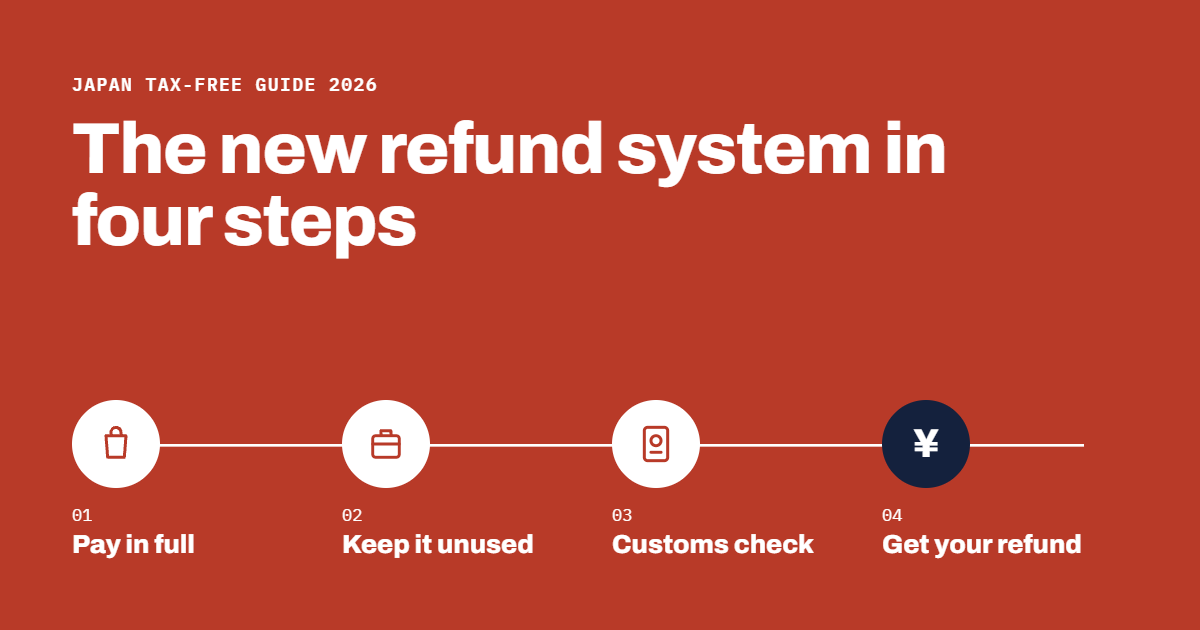
If you read only one section, make it this one. Each step links to the details further down.
- In the shop: pay full price and register your refund
- Look for the “Tax-Free” sign (popular tax-free shops) and spend at least ¥5,000 (excluding tax) at one shop on one day.
- Show your passport, pay the tax-inclusive price and register your refund method.
- Prepare for departure: keep everything ready for the check
- Keep tax-free purchases unused and keep your receipts together. (The Receipt Rule)
- Make sure you will leave Japan within 90 days of each purchase.
- Departing from Narita, Haneda, Kansai, Chubu, Fukuoka, New Chitose or Naha? Set up Visit Japan Web so you can do the airport check on your phone within the designated Wi-Fi area in the international departure lobby.
- At the airport: customs check before bag drop
- Plan to arrive earlier than usual.
- Go to the tax-free terminal in the international departure lobby first, with all your purchases, including any in the suitcase you will check in.
- Scan your passport. Green means you are done. Red means you show your items at the customs inspection area.
- Only then check in your bags. Checked luggage cannot be retrieved for the check. (step-by-step guide)
- After departure: receive your refund
- The shop or its refund operator pays you using the method you registered. Customs does not pay out refunds. (refund details)
The Big Change: Instant Exemption vs. Refund
For years, eligible visitors could show their passport at a Japanese shop and have consumption tax removed from the bill on the spot.
That changes on 1 November 2026.
The reform is designed partly to prevent abuse of the tax-free system, including cases in which goods bought tax-free were resold inside Japan rather than taken overseas. Under the new system, tax-free status is confirmed only after Customs verifies that the eligible goods are leaving Japan.
| Feature | Until 31 Oct 2026 | From 1 Nov 2026 |
|---|---|---|
|
What you pay in the shop |
Tax-free (tax deducted on the spot) | Full tax-inclusive price |
| At departure | Customs may check your goods | Customs check at a tax-free terminal is required for a refund |
| Who pays you back | No refund needed | The shop or its refund operator, after the customs check |
| Consumable packaging | Sealed in special bags | Special packaging abolished |
|
Product categories and limits |
General goods and consumables counted separately (unless general goods were sealed like consumables); consumables capped at ¥500,000 per shop per day |
No categories; everything counts towards the ¥5,000 minimum, and no upper limit beyond what you can carry out yourself |
| Export deadline | Varied by item type | Customs confirmation within 90 days of purchase |
The cutoff rule: purchase date decides
Which system applies depends on your date of purchase, not your flight date. If you buy a camera on 30 October, you get the old in-store exemption. If you buy an extra lens on 2 November, you pay full price and claim the tax back through the customs check at departure.
Is your trip crossing 1 November?
Suppose you arrive on 28 October and fly home on 5 November. You will then have purchases under both systems:
- October purchases follow the old rules. Consumables may come in sealed bags, so keep them sealed and follow the existing departure requirements.
- Purchases from 1 November onwards follow the new refund system and require customs confirmation under the new rules.
If you’re unsure which rules apply to a particular purchase, ask the shop when you buy and keep your receipts organised by date.
Eligibility & Purchase Rules
Who qualifies
Tax-free shopping is for eligible visitors such as foreign tourists on a temporary stay. Japanese citizens who have lived abroad continuously for two years or more also qualify; under the new system, a My Number Card showing that you moved abroad is also accepted as proof. The full list of who qualifies and which documents to show is published by the Japan Tourism Agency.
The ¥5,000 minimum: categories combined
You need to spend at least ¥5,000 (excluding tax) at the same shop on the same day. From 1 November, general goods (clothes, electronics, shoes) and consumables (snacks, cosmetics, skincare) count together. A ¥3,500 graphic T-shirt plus ¥1,800 of matcha sweets now qualifies.
The consumption tax included in the purchase is generally 8% for eligible food and non-alcoholic drinks and 10% for most other goods. Your actual refund may be lower if the shop or refund operator charges a handling fee.
Limits and exclusions
- Under the standard tourist tax-free procedure, you generally need to take the goods out of Japan with you. The old option of mailing tax-free purchases home yourself ended on March 31, 2025. A separate direct-shipping procedure may be available when shipping is arranged through the seller.
- Gold and platinum bullion and goods that are not subject to consumption tax are excluded.
- For items with a unit price of ¥1,000,000 or more (excluding tax), Customs may ask to see a certificate of authenticity or a guarantee.
- Posting tax-free goods home yourself is no longer allowed; this option ended on 31 March 2025. Some shops offer overseas shipping, so ask the shop directly.
No more sealed bags, but goods must stay unused
The bulky sealed plastic bags for consumables are gone, so you can pack freely. However, food, drinks and cosmetics must still leave Japan unused. If you eat those snacks or use that perfume, you cannot receive the refund for it.
The Receipt Rule: why you should split your purchases
This is the rule most travellers miss. Customs checks your purchases one receipt at a time. If even one item on a receipt is missing (eaten, used or given away), you lose the refund for every item on that receipt.
Tip: if you buy a ¥30,000 skincare set and a few boxes of snacks you might open on the train, pay for them separately. Eating the snacks then costs you only the refund on the snacks, not on the skincare set.
If you have consumed some items, do not use the terminal for that purchase. Instead, tell the customs officer at the counter. You simply won’t receive the refund for that receipt. You already paid the tax at the shop, so no extra tax is charged.
The 90-day limit
You must leave Japan and complete the customs check within 90 days of the purchase date. Typical holidays fall well within this, but long-stay travellers should watch the dates on their early purchases.
Where to Shop Tax-Free: Popular Shops at a Glance
Most big chains offer tax-free shopping, but “tax-free chain” does not always mean “every branch”. Use this table to plan, then confirm on the shop’s official store finder before you go. Most chains’ pages still describe the pre-November rules, so details such as minimum amounts and packaging may change after 1 November.
| Shop | Tax-free availability | Good to know | Traveller-friendly branches |
|---|---|---|---|
| UNIQLO | ✅ Most shops | Some shops are excluded; check the store locator. Purchases from different UNIQLO shops cannot be combined, and online orders (including in-store collection) are not eligible. | UNIQLO Ginza, UNIQLO Asakusa |
| GU | ✅ All shops (per GU’s official page) | UNIQLO’s sister brand. Check the store finder if you’re visiting a small branch. | GU Ginza, GU Shinsaibashi (Osaka), GU Tenjin (Fukuoka) |
| MUJI | ⚠️ Selected shops only | Not all MUJI shops are tax-free. MUJI publishes an official list of tax-free shops. | MUJI Ginza, Shinjuku-dori, Shibuya Koen-dori, Kyoto Porta, Kyoto BAL, Shinsaibashi PARCO, Namba CITY, LUCUA Osaka, Grand Front Osaka |
| Don Quijote (Donki) | ✅ Widely available | Tourist-area shops have dedicated tax-free counters, and some run extra tax-free discount coupons. | MEGA Don Quijote Shibuya Honten, Shinjuku Kabukicho, Akihabara, Asakusa, Dotonbori, Umeda Honten, Kyoto Shijo Kawaramachi, Fukuoka Tenjin Honten |
| LOFT | ⚠️ Varies by shop | Each shop page lists its own “Tax Exemption Procedure Time,” which usually ends 30 minutes or more before closing. | Shibuya, Ikebukuro, Ginza, Shinjuku Sanchome, Tokyo Solamachi, Kyoto, Umeda, LUCUA Osaka, Tenjin |
| Hands | ✅ Most shops | Some shops excluded. Pay at the regular register first, then take your receipt and passport to the tax-free counter the same day. Receipts from other shops in the same building can’t be combined. | Shinjuku, Shibuya, Ginza, Yokohama, Sapporo |
| BicCamera | ✅ Widely available | Great for electronics, cosmetics, and medicine. Under the current rules, items from the liquor corner can’t be combined with other purchases, so ask how this works after November 1. | Ikebukuro Main Store, BicCamera AKIBA, Yurakucho, Shinjuku West Exit |
| Matsumoto Kiyoshi / Cocokara Fine | ⚠️ Varies by shop | Drugstores. The official store finder shows a tax-free icon for each eligible branch. Large shops in tourist areas are the safest bet. | Branches in Shinjuku, Ginza, and Kyoto’s Kawaramachi/Shinkyogoku area. Check each branch’s tax-free icon. |
| DAISO | ⚠️ Don’t assume | There’s no chain-wide tax-free policy. Some shops inside shopping malls may let you use the mall’s own tax-free counter. Most items cost ¥110–¥550, so reaching ¥5,000 takes a full basket. | Ask the individual shop or mall |
Store-level tips
- Each shop counts separately. The ¥5,000 minimum applies per shop, per day. Buying ¥3,000 at two different UNIQLO branches doesn’t add up.
- Department stores and malls often have a shared tax-free counter for the whole building. Ask at the information desk whether receipts from different floors can be combined.
- Tax-free counters close early. Plan big shopping trips for earlier in the day, not right before closing.
- Entry stamp. If you plan to shop tax-free, make sure you receive an entry stamp or landing permission record when entering Japan, including when using an automated gate. You’ll also need this information to set up the Visit Japan Web tax-free QR code.
At the Airport: Step by Step
The customs check must be finished before you check in your bags, and it takes place in the international departure lobby.
- Go to the tax-free terminal first. Tax-free terminals (kiosks or electronic terminals) and customs inspection areas are in the international departure lobby, before bag drop. Bring all your tax-free purchases, including the ones you plan to check in.
- Or use Visit Japan Web. At Narita, Haneda, Kansai, Chubu, Fukuoka, New Chitose and Naha, you can do the check online instead. Connect to the dedicated Wi-Fi in the departure lobby (available up to the security checkpoint) and complete the procedure on your phone.
- Scan your passport and check the result. It takes only a few seconds. Green means no inspection is needed and your check is complete. Red means you take your passport and purchases to the customs inspection area and show them to an officer.
- Check in your bags only after the check. You must have all your purchases with you when you scan your passport. According to the Japan Tourism Agency, checked luggage cannot be retrieved for the check, so do not count on the airline returning a bag.
This matters most for liquids. Cosmetics or Japanese whisky over 100 ml cannot go in your hand luggage, so take your suitcase to the terminal first, complete the check (and any inspection), then check it in.
Receiving your refund
After Customs confirms the export and the shop verifies the purchase record, the shop or its refund operator pays you. Methods vary by shop and may include bank transfer, credit card, app payment or cash at the airport. Timing also varies, and some refund operators deduct a handling fee, so ask at the till how and when you will be paid and whether a fee applies.
Connecting flights and cruises
- Domestic flight to an international flight: do the customs check at your final departure airport (the last airport before leaving Japan).
- Cruise from a Japanese port to overseas: do the check at the last Japanese port, before handing over your luggage.
- Fly and cruise (a round-trip cruise from Japan, then flying home): do the check once, at the airport you fly home from.
Is the Refund Worth Your Time?
Because the initial check starts with a single passport scan, adding smaller eligible purchases does not necessarily add much time—although a RED result may require a physical inspection. If you have one big purchase, you’ll be at the terminal anyway, so it’s worth including the small ones too.
| Total spent (excl. tax) | Approx. refund at 10% | Our take |
|---|---|---|
| ¥5,500–¥15,000 | ¥550–¥1,500 (~$4–$10) | Worth it if you’re already doing the check, or if you use Visit Japan Web. If it’s your only purchase and time is tight, you can skip it. You just won’t get the tax back. |
| ¥30,000–¥60,000 | ¥3,000–¥6,000 (~$20–$40) | Claim it. Arrive a little earlier to be safe. |
| ¥100,000+ | ¥10,000+ (~$65+) | Definitely claim. Bring warranties or certificates for high-value items. |
Dollar amounts are rough estimates at about ¥150 per USD. Food is refunded at 8%, so those amounts will be slightly lower.
How early should you arrive?
The customs check, including any inspection, must be finished before you check in. If you miss your flight because of the tax-free procedure, neither the airline nor Customs will compensate you. Especially in the first weeks after 1 November, when queues may be longer, allow extra time on top of your airline’s usual guidance, and check your airport’s latest information.
Frequently Asked Questions
Can I still shop tax-free at Don Quijote and Bic Camera?
Yes. Tax-free shops continue to offer tax-free purchases, but from November 1 you pay the tax-inclusive price at checkout. The shop records your purchase and refund method. After you complete the customs check at the airport, you receive your refund.
What if I eat or use some of my tax-free items before leaving?
Then you cannot get the refund for that receipt, including the other items on it. Don’t use the terminal for that purchase. Tell the customs officer at the counter instead. To avoid this, pay separately for anything you might use during your trip.
Can I pack tax-free items in my checked suitcase?
Yes, as long as you complete the customs check before checking the suitcase. If you get a Red result, the officer needs to see the items. Once a bag is checked, it cannot be retrieved.
Is tax-free shopping being abolished in Japan?
No. Eligible visitors still get the consumption tax back (8% on food and non-alcoholic drinks, 10% on most other goods). What changes is the timing: you pay first and get the refund after the customs check.
Is there a penalty for not taking items out of Japan?
Yes, if you completed the customs check. If you complete the customs check and then don’t take the items out of Japan, the exempted tax will be collected and penalties may apply. Only complete the check for goods you are actually taking with you.
Japan’s new tax-free shopping system may require an extra step, but saving on purchases is still worthwhile. Whether shopping at UNIQLO, MUJI or Don Quijote, remember to keep your purchases, prepare your passport and complete the customs check before checking in your luggage. Happy shopping!
For more information about shopping in Japan, please check out these posts, too!


Written by
"The world is my oyster." As a dedicated globetrotter and hammock enthusiast, I’ve spent years chasing new experiences, collecting stories, and discovering the world’s most incredible destinations. Born and raised in Japan, I’ve always had a deep connection to my roots, but my love for adventure has led me to spend over a decade exploring countries across the globe—from culture-rich cities to remote hideaways.
Travel isn't just a hobby for me; it's a lifestyle. I'm constantly searching for new ways to fuel my wanderlust. Over the years, I’ve developed a wealth of knowledge and a treasure trove of tips that make traveling more enjoyable, practical, and meaningful.
Through my experiences, I've come to appreciate not only the beauty of travel but also the importance of understanding diverse cultures, embracing the unfamiliar, and stepping out of my comfort zone. My travels have shaped who I am today, and I’m excited to share those lessons with others.
With Japan Web Magazine, I aim to offer practical advice, insider tips, and firsthand stories that help travelers navigate their journeys to Japan or setting off on a global adventure. From hidden gems in Japan to travel hacks that make any trip smoother, I hope my insights inspire you to embark on your own adventures and make the most of every moment. Let’s explore the world together!
You can also find my stories here ▶ https://medium.com/@nahobm
- +3 3
-
-