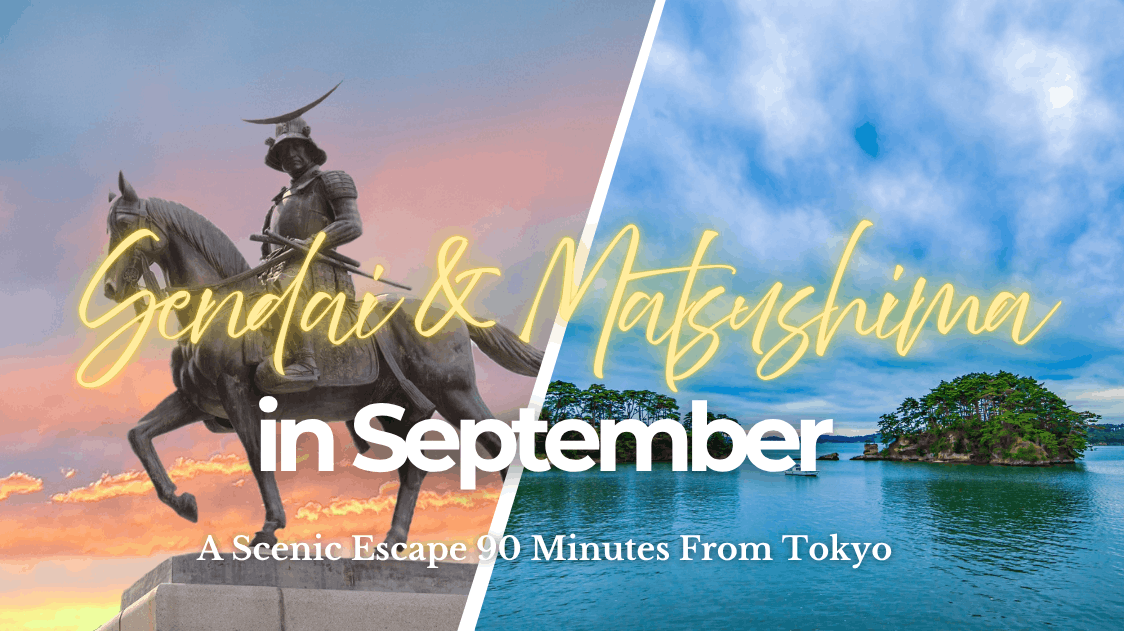
Sendai & Matsushima in September: A Scenic Escape 90 Minutes From Tokyo
Ride the Shinkansen north for jazz, history, seafood, and one of Japan’s most celebrated coastal views

- +0 0
-

-


The bullet train leaves Tokyo, and for the first forty minutes you are still in the sprawl — apartment blocks, rice paddies squeezed between warehouses, the occasional glimpse of hills beyond the window. Then the landscape opens out, the train settles into its long northern stride, and before you have finished your coffee the announcement comes: Sendai. Sendai desu.
Around one hour and thirty minutes. That is it. That is the distance between central Tokyo and a place where, later that same day, you can stand by Matsushima Bay, look across hundreds of pine-covered islands, and hear little but water.
Yet Sendai and Miyagi Prefecture remain outside the classic Tokyo–Kyoto–Osaka itinerary followed by many first-time visitors. Here you have a city shaped by the legacy of the Date clan, Matsushima — traditionally celebrated as one of Japan’s Three Scenic Views — and some of the seafood for which Japan’s Pacific coast is famous.
September is an especially interesting month to make the trip. Here is how to do it, what it costs, and a few things worth knowing before you get there.
Why September, Specifically

Japan in September is a strange, in-between month, and Miyagi is where that can work in your favor.
The weather gradually becomes more comfortable. Sendai generally experiences cooler conditions than Tokyo and Kyoto, particularly as September progresses. Early September can still be warm and humid, but as autumn approaches, the conditions can become increasingly comfortable for a full day of walking around the city or Matsushima Bay.
The Obon travel peak is over. Japan’s major summer holiday period falls around mid-August, making it one of the busiest times of the year for domestic travel. September comes after that peak. That does not mean Sendai or Matsushima will be empty — weekends, holidays and major events can still draw crowds — but it can be an appealing time to explore Tohoku after the height of the summer travel season.
The daylight is still long — and this matters more than you think. Zuiganji, the great Zen temple at Matsushima, closes at 17:00 through September. In October that drops to 16:30, in November to 16:00, and by January it closes at 15:30. September therefore gives you more usable sightseeing time than the months that follow, especially if you are combining temples, bridges and a sightseeing cruise in one day.
And there is the jazz. Every September, Sendai hosts the JOZENJI STREETJAZZ FESTIVAL. Performances take place across dozens of venues throughout the city center, including Jozenji-dori, Kotodai Park, Nishi Park, the shopping areas, and around Sendai Station. Standard performances generally run from 11:00 to 17:30, with some programming continuing later depending on the stage.
Admission to the regular street performances is generally free. You do not need to build the entire day around a ticketed venue: part of the appeal is simply walking through central Sendai and coming across live music along the way.
One seasonal caveat worth knowing: September falls just before Matsushima’s main oyster season, which generally runs from October through March. If grilled oysters are the entire reason for your trip, come a little later. September, however, still gives you plenty of other Miyagi seafood to work with — from sushi in Shiogama to seasonal fish served around Matsushima.
Getting There: The Ninety-Minute Part

The Tohoku Shinkansen connects Tokyo Station with Sendai in as little as around 1 hour 30 minutes on the fastest Hayabusa services.
That makes Sendai unusually easy to add to a Tokyo itinerary. You can leave the capital in the morning, spend the day sightseeing in Sendai, and still have another full day available for Matsushima without ever needing a domestic flight or a long transfer.
A one-way ordinary-car reserved-seat ticket typically costs around 11,000 yen –12,000 yen, depending on the train and travel date. Check the latest fare when booking.
Two things worth knowing:
- Hayabusa services are fully reserved. There is no non-reserved carriage to simply jump into, so reserve your seat before boarding.
- Choose the ticket that fits your wider itinerary. If Sendai is your only major trip from Tokyo, individual Shinkansen tickets may be the simplest option. Travelers planning to explore several destinations across eastern Japan should also compare the JR EAST PASS, which offers unlimited travel across a broad area of the JR East network during its validity period.
Book Your Shinkansen Tickets Online
Travel from Tokyo to Sendai in around 90 minutes by Shinkansen, then continue your journey to Matsushima.
You can reserve the Tokyo → Sendai leg online in English in advance with Japan Bullet Train. Reserve your seats online before your trip and collect your tickets at the station using the QR code sent by email.
Once you arrive, the railway continues to do most of the work. Sendai’s central sights are relatively compact; the Loople Sendai sightseeing bus connects many of the historical stops, and the JR Senseki Line provides a straightforward link toward Shiogama and Matsushima for day two.
Day One: Sendai, the One-Eyed Dragon, and the Best Thing You Will Eat All Trip
Zuihoden — climb it; it is worth the legs

Sendai was developed under the rule of Date Masamune, the powerful feudal lord remembered for his crescent-moon helmet, his ambitious diplomacy, and the nickname “One-Eyed Dragon.” In 1613, he sent an embassy led by Hasekura Tsunenaga across the Pacific and Atlantic to Europe.
Masamune is buried on a wooded hill above the Hirose River at Zuihoden, one of Sendai’s most memorable historical sites.
Getting up there requires a little effort. From the bus stop, the approach climbs through a forested slope and up a series of stone steps. The uphill walk is noticeable, particularly on a warm September afternoon, but the wooded setting is part of the experience.
The deeper you go, the quieter the city becomes.
Then the trees part and there it is: black lacquer, gold, vermilion, carved dragons, phoenixes and elaborate ornamentation crowded under the eaves. The visual style reflects the decorative culture associated with the late Momoyama and early Edo periods and with the Date clan itself.
What is not obvious from photographs is that the structure you see today is a reconstruction. The original mausoleum was designated a National Treasure in 1931 but was destroyed during the Sendai air raid in 1945. Zuihoden was reconstructed in 1979, and archaeological excavations associated with the restoration revealed remains and burial objects connected with Masamune.
Some of the discoveries are displayed in the museum within the grounds, adding a surprisingly tangible human dimension to a figure normally encountered through armor, statues, and history books.
Practical: Adult admission is 570 yen. From February through November, Zuihoden is open 9:00–16:50, with last admission at 16:30. Take the Loople Sendai sightseeing bus from Sendai Station. A single ride costs 260 yen, while a one-day pass costs 630 yen and can be useful if you plan to visit several sightseeing stops around the city.
Gyutan — two easy ways to try a Sendai classic

Sendai’s signature dish is gyutan: beef tongue sliced relatively thick, seasoned and grilled, commonly served with barley rice, clear tail soup and nanban miso, a spicy green-chili miso.
The Sendai-style dish is generally traced to chef Keishiro Sano, who began serving grilled beef tongue in the city in the years following World War II.
There are two particularly easy ways to try it.
If you have one meal and a train to catch: head to Gyutan-dori, the beef-tongue restaurant area inside Sendai Station. Several of Sendai’s best-known gyutan brands have branches here, making it an easy option when arriving by Shinkansen or before boarding your return train.
It is convenient, central, and — importantly on a tightly planned trip — requires no additional journey across town.
If you want a more historic experience: head into central Sendai for Aji Tasuke, which is closely associated with the origins of Sendai-style gyutan and remains one of the city’s best-known traditional specialists.
The restaurant is small, so it is worth allowing extra time during busy lunch periods. The appeal here is not an elaborate dining experience but a focused version of the dish that made Sendai’s beef tongue famous in the first place: thick slices of grilled meat, barley rice, and soup, served with little distraction.
Compared with more polished modern interpretations, the flavors can feel deeper and more robust, while the barley rice and peppery soup complete a distinctly old-school Sendai meal.
Whichever route you choose, do not ignore the nanban miso. It may look formidable, but a little of it alongside the beef tongue is part of the classic combination.
The evening

Sendai after dark still feels very much like a working regional city rather than a sightseeing district that shuts down once the temples close.
Kokubuncho is Sendai’s main nightlife district, while the long covered shopping arcades around the center remain active into the evening. Restaurants, izakaya and bars are concentrated within walking distance of the central station area.
And if you are here during the JOZENJI STREETJAZZ FESTIVAL, your evening may require very little planning. Follow the music.
Day Two: Matsushima Bay

From Sendai Station, take the JR Senseki Line to Matsushima-Kaigan. The journey takes around 40 minutes with no transfer on direct services, making Matsushima an easy day trip from Sendai.
Two pieces of advice will improve the journey:
- Try the right-hand side of the train. When traveling from Sendai, the right side can offer views toward the water as the line approaches Matsushima-Kaigan.
- Get off at Matsushima-Kaigan, not Matsushima. There are two similarly named stations on different lines. Matsushima-Kaigan Station puts you within easy walking distance of the main sightseeing area, including the waterfront, Godaido and Zuiganji.
If you are carrying substantial luggage, leaving it in Sendai also makes the day considerably easier.
The cruise, and another way to plan the route

There are two useful ways to see Matsushima Bay by boat, and they should not be confused, as they are operated as separate services.
If you are already in Matsushima, the Matsushima Island Sightseeing Boat(Matsushima shima-meguri)’s Niomaru Course is a straightforward option. It is a roughly 50-minute sightseeing loop that departs from and returns to Matsushima, passing many of the bay’s distinctive islands.
But there is another option worth knowing about — especially if you want the boat to become part of the journey rather than simply an attraction.
Instead of traveling directly from Sendai to Matsushima-Kaigan, take the JR Senseki Line to Hon-Shiogama Station first. From there, walk to Marine Gate Shiogama and board Marubun Matsushima Kisen’s Basho Cruise, a one-way cruise linking Shiogama with Matsushima.
The course takes approximately 50 minutes and passes islands including Niojima and Senganjima while crossing Matsushima Bay. From Shiogama, departures are currently scheduled hourly from 9:00 to 15:00. A standard second-class adult ticket costs 1,500 yen, with higher-class seating also available.
So your route becomes:
Sendai → Hon-Shiogama by JR Senseki Line → Shiogama → sightseeing cruise across Matsushima Bay → Matsushima → Matsushima-Kaigan Station → Sendai by JR Senseki Line
It is a particularly satisfying itinerary because the railway and boat work together rather than forcing you to backtrack. You can also use the stop in Shiogama for an early seafood or sushi meal before boarding.
And there is something fitting about arriving in Matsushima by water — a small nod to the bay’s long association with poet Matsuo Basho and his journey through northern Japan.
Once you are out on the water, the islands stop looking like a single landscape and begin to separate into individual formations — narrow rock stacks, arches, weathered cliffs and tiny pines holding improbably to exposed stone.
*Note: Seabirds may also appear around the boat, but do not feed them. Feeding black-tailed gulls and other seabirds in Matsushima Bay has been prohibited since 2014 as part of efforts to protect the bay’s pine trees from damage associated with large concentrations of birds.
One practical consideration is the weather. Sightseeing cruises may be canceled or routes adjusted when wind and sea conditions make operations unsafe. September also remains within Japan’s typhoon season, so check the weather forecast and the operator’s latest service information before setting out.
Fortunately, Matsushima works perfectly well even if the boat does not.
Godaido — small, free, and unmistakably Matsushima

A few minutes from the main waterfront, on a rocky islet just offshore, sits Godaido.
The current hall was built by Date Masamune in 1604 and is regarded as the oldest surviving example of Momoyama-period architecture in northeastern Japan. It is small, simple compared with the grander temple structures nearby, and one of Matsushima’s most recognizable landmarks.
Getting there is part of the experience.
The short approach includes sukashi-bashi — “see-through” bridges constructed with deliberate gaps between the planks. You can see the water below your feet as you cross. Traditionally, the design encourages visitors to watch their step and compose themselves before approaching the sacred hall.
It also means this is not the ideal place for high heels, and visitors with pushchairs or mobility concerns should take particular care.
Inside Godaido are statues of the Five Great Wisdom Kings, normally hidden from public view. The main unveiling takes place only once every 33 years, with the next currently scheduled for 2039.
There is also an annual festival on August 20, although the September traveler will encounter Godaido in its usual quieter state.
Do not come expecting a vast temple hall. Come for the small wooden structure, the bridges, the rock beneath it and Matsushima Bay opening behind it.
Zuiganji — the one you actually pay for

Then walk inland through the approach toward Zuiganji, one of the most important Zen temples in the Tohoku region.
Its history stretches back more than a thousand years, while the present temple complex was extensively rebuilt under Date Masamune and completed in the early 17th century. The main hall and kuri, or temple kitchen, are designated National Treasures.
Adult admission is currently 1,000 yen.
Inside the main hall, different rooms carry their own decorative character: painted sliding doors, carved transoms, elaborate ceilings and gold-leaf surfaces associated with the culture of the Date domain.
Photography is restricted inside the main buildings, so check the current rules and signage during your visit. Either way, this is one place where putting the phone away improves the experience. Without a screen in front of you, it is easier to notice the tatami, the old timber and the way natural light catches the decorated interiors.
Do not leave immediately after the main buildings.
The path along the cliffs near the temple entrance passes a series of caves and rock-cut niches connected with centuries of memorial rites. Stone monuments and Buddhist figures line the rock face, giving this part of the grounds a very different atmosphere from the nearby ornate interiors.
Allow roughly 30–40 minutes for the main visit, longer if you like temples. In September, Zuiganji is open from 8:30 to 17:00, with last admission at 16:30.
Entsuin, and the European connection

Immediately next door, Entsuin is the mausoleum of Date Mitsumune, grandson of Date Masamune, who died young in the 17th century.
The grounds bring together several different styles of garden, including moss-covered areas and a dry landscape garden, but the most intriguing details are inside the mausoleum itself.
Look closely, and you can spot rose motifs and Western-influenced decorative elements, often discussed in connection with the Date domain’s early-17th-century contact with Europe.
Masamune’s domain was behind the Keicho Embassy, which sent Hasekura Tsunenaga across the Pacific and eventually to Europe during an extraordinary period of international contact shortly before Japan’s policies toward Christianity and overseas relations became far more restrictive.
The motifs here are subtle, which is exactly why they are easy to miss.
Fukuura Island, if you have an hour left

A 252-meter vermilion bridge runs out to Fukuurajima, a small wooded island covered with walking paths, vegetation and viewpoints across the bay.
The bridge toll is currently 300 yen for adults and 100 yen for elementary, junior high, and high school students. From April through October, access is available from 8:30 to 17:00.
You do not need half a day. Around thirty minutes to an hour is enough for a relaxed walk through the island, depending on how often you stop.
The viewpoints on the far side offer especially attractive perspectives across Matsushima Bay — less about one famous landmark and more about seeing the islands layered against one another from the water’s edge.
Eating

Matsushima itself has plenty of seafood restaurants, cafés and casual places to stop between the temples and waterfront.
But if you choose the Shiogama → Matsushima cruise route, then Shiogama is worth including in the food plan.
Shiogama is one of Miyagi’s major fishing ports and is particularly well known for tuna and sushi. Restaurants around the city make it a natural place for breakfast, an early lunch, or a sushi stop before walking to Marine Gate Shiogama for the Bashō Course.
That creates one of the neatest versions of the entire day:
JR from Sendai → seafood in Shiogama → Matsushima Bay by boat → temples and bridges on foot → JR from Matsushima-Kaigan back to Sendai.
No car required, very little backtracking, and the journey itself becomes part of the sightseeing.
One Last Honest Note

Matsushima rewards travelers who give it time.
It is tempting to arrive, take one photograph of the bay and move on. But the landscape makes more sense when you spend the day moving through it — crossing red bridges, stepping into temples, walking under cedar trees and watching the same islands rearrange themselves every time you reach a different stretch of shoreline.
Give it a full day if you can.
Better still, stay into the late afternoon, when some of the day-trippers begin heading back toward Sendai and the atmosphere around the waterfront changes.
And that is perhaps the real appeal of combining Sendai and Matsushima in September. The journey does not require a complicated expedition into rural Japan. From Tokyo, the Tohoku Shinkansen gets you to Sendai in around ninety minutes. From there, the JR Senseki Line carries you onward toward Shiogama and Matsushima Bay.
Ninety minutes from Tokyo. Two days. A city, a bay, and September before the autumn daylight begins to shorten.
Book Your Shinkansen Tickets Online
Travel from Tokyo to Sendai in around 90 minutes by Shinkansen, then continue your journey to Matsushima. Reserve your seats online before your trip and collect your tickets at the station using the QR code sent by email.
Written by
Established in 2016, Japan Web Magazine is a long-running online media platform dedicated to sharing the beauty and uniqueness of Japan with a global audience. Our team is made up of passionate Japan lovers—both Japanese and international writers—who bring a diverse and authentic perspective to every article. We cover everything from must-visit travel destinations across Japan, to local food recommendations, shopping guides, and practical travel tips. In addition to tourism content, we also delve into Japan’s rich cultural tapestry, introducing readers to traditional customs, festivals, and the latest trends in modern Japanese pop culture, including anime and entertainment. Driven by a genuine love for Japan, our mission is to connect readers around the world with the wonders of this incredible country.
- +0 0
-
-